Monday, 15 June 2015

Shakespeare’s Globe Exhibition

21 Globe Walk
Southwark SE1 9DT
Thursday June 11th 2015


Linda chose the Bus route 63 on a bad day and was thus late for this early morning (by Museum standards) meeting Bankside, as the locals have it. Fortunately it was a lovely summer’s day with our spirits rising almost as high as the tides lapping the riverside walk; you can easily get splashed in places.
We have been to several different performances at the seasonal theatre (April 23 to mid October) but this was the first time either of us had joined a tour. The entrance price  includes an exhibition as well as a tour of the auditorium. Today there was something of a rehearsal taking place which meant no talking and no photos inside, which was a shame as the day was sunny and the ceiling, depicting of course the Heavens from whence Jupiter might descend (a la Cymbeline), would have looked good in a close up (having only sat on the highest level when attending performances we were impressed at how wondrously colourful it is).  I had a fancy to step onstage too…

We actually started the exhibition but then joined our 10.00 am tour returning to the displays at the end but I would l say you need to give yourself plenty of time for the downstairs information boards as they give an excellent introduction to the theatre, the playwright and  London at the time – perhaps less so for an overall historical context.

If you have ever ‘done’ i.e. studied (and thanks to Mr Gove they are now compulsory) or acted in a Shakespeare play you will be familiar with the sort of information that appears in most introductions. London proper – commerce, government, justice and nobility were all on the north side of the river while Southwark and Bankside were full of entertainments ranging from brothels to inns to animal fights of all kinds. Plays were performed indoors in hostelries and sometimes the courtyards of the wealthy or inns of court but there were also four purpose built theatres – the Rose,  the Swan, the Globe and the Curtain  though the last was just outside in a less riverside setting. Each theatre had its own actors’ company and its own playwright and probably William S. acted as well. (Let’s face it the film 'Shakespeare in Love'  does this bit better than most talks, or our blog.)


The Globe we see today is the third incarnation – the original, for which Will Shakespeare as part of the Lord Chamberlayne’s Men would have written, stood from 1599-1613, when it famously burnt down after a rogue spark from a cannon fired during a performance of Henry VIII ignited the thatch. The replacement Globe was closed/pulled down under Oliver Cromwell’s more puritanical regime in 1642. The site was not here, Thames side ( the Thames was wider in those days) but along near a brewery in Bermondsey.  In 1949 the young actor  Sam Wanamaker arrived in the UK and decided there needed to be a replica theatre. Between the fund-raising and the health & safety concerns – thatch rooves were outlawed In London following the Great Fire of 1666 – it was 1997 when the current building opened for performances, too late for Sam himself who had died in 1993. The downstairs exhibition shows quite clearly the composition of the thatch, which you will be relieved to hear, is well salted with sprinklers. It is a testament to the success of the theatre and the continued fund-raising that the additional theatre – the Sam Wanamaker, and a horseshoe shaped Jacobean replica took comparatively fewer years to come to fruition – these performances fill in the winter months when the Globe is closed. While there were clear drawings of the Jacobean models in Worcester College, Oxford, the guides describe this Globe as a ‘best guess’ based mainly on the remains of the nearby Rose Theatre. The Sam Wanamaker holds only 340 seats as compared to the 1000+ able to watch drama in the Globe. Many of those will pay just £5 as ‘groundlings’. In Shakespeare’s day the cost to stand and heckle, eat and probably all the other bodily functions was 1d, 2d for seat and 3d for a seat +cushion. Nobility sat in boxes by the stage as much to be seen as spectate themselves. One penny would have been equivalent to half a worker’s weekly wage…


The two central pillars, painted to look like marble are in fact ‘green’, or young oak now splitting slightly it has to be said. The ‘roof ’over the stage (the rest of the auditorium is more or less exposed to the elements) is painted to look like the celestial heavens complete with trapdoor. The square stage represents earth and the further trapdoor below leading to ‘hell’ and other dark places. (Witches please enter from below…)

The exhibition, though containing few actual artefacts, covers the origins of Elizabethan theatre in London, what Bankside would have been like and a very sweet model of the ‘Frost Fair’ – the Thames frozen enough to support all manner of winter fun and games.  There are a few shards of what would have been beer bottles (beer being more drinkable than dodgy water) and no shortage of hazelnut shells indicating that the audience liked to nibble while it watched – more exotic nuts had been found and of course the theatre was not far from the docks.

Also in abundance are the wealth of quotes – interestingly not just the ‘old chestnuts’ from the famous speeches but the everyday expressions we continue to use still on a daily basis. The exhibition is dotted with different ‘talking heads’. It really comes alive in the ‘attiring house’ – ‘wardrobe’ in modern parlance – section with film of dressing Mark Rylance as Cleopatra in an ‘original practice’ (what we would  call ‘all male’ production as women were not permitted  to perform in the theatre until the re-instatement of the monarchy and Charles II). Wardrobe essentials are nicely recreated with herbs etc for dyes.  Costumes were given far more prominence than sets or even lighting (most productions relying on daylight after all).


Similarly space is devoted to explaining and demonstrating the composition of plaster (the wall kind) and thatch, and to contemporary special effects.  Shakespeare’s audience were fairly inured to blood and gore, after all the alternative entertainments involved quite a lot of animal cruelty,  and so several plays (Titus Andronicus for example)  necessitated copious amounts of fake blood and limb loss, which the then stage management  was well able to convey realistically.
A rather good interactive programme allows you to identify and then hear played the contemporary instruments as music is very integral to many of Shakespeare’s plays .    


In summary the exhibition is well worth a visit – however if you have time and inclination going to a production would seem the best way to see the theatre itself rather than the somewhat tokenistic tour that we experienced in a shuffling crowd. The whole complex is much larger than would appear from the river and it can get quite confusing once inside.


Wednesday, 3 June 2015

The Estorick Collection of Modern Italian Art


The Estorick Collection of Modern Italian Art

39a Canonbury Square N1 2AN 

The Estorick Collection is a fine example of something which does exactly what it says on the tin.  It is very easy to get to, being a brief step away from Highbury and Islington Station.  So Linda and I met via different bits of the Overground, and paused to hope that Mary was having good weather in North Wales.

The Estorick is housed in a Georgian terrace house, of which the top floor is a library rather than a gallery space.  The ground floor has a modern extension, which is where the current special exhibition is displayed, and that's where we went first. There were two rooms of works by Amedeo Modigliani, mostly drawings and mostly from the collection of Richard Nathanson.  Many of them had been owned by Paul Alexandre, a close friend and early patron of Modi (as he sometimes signed himself)

The drawings were quite early works, and  only a few of them had the elongated forms that we, like many people, associate with the artist.  Several were the merest sketches, such as one might expect an art student to produce.  We were also amused to see that he used both sides of the pages of his sketch books, obviously thinking about his drawing and not the potential saleability of product. The information on the walls said that, although Modigliani lived in Paris, he was not excited by the work of Braque and Picasso, preferring to look for a way to show timeless beauty, as exemplified by the Egyptian works he studied in the Louvre.  This meant that the drawing on display were often the merest outline of naked women, occasionally with more detail around the face.


He was also clearly interested in the caryatid form, and there were several sketches of women with their arms raised as if load-bearing.

Some of the works, including a couple of interesting oil portraits, were from the collection amassed by Eric and Salome Estorick, who travelled Europe looking for art works in the years after the Second World War.

The rest of the Collection is the result of their single minded interest in Italian Futurist Art, and is displayed upstairs.  Many of the artists represented here were followers of Marinetti's Manifesto of 1909, which you can read here, and felt that Art Galleries and Museums were like cemeteries of the spirit, and artists should concentrate on crowds, machinery and so on.  Many of these artists were also Fascists, which of course made living and working in Mussolini's Italy more straightforward for them.


 We saw works by Soffici, Balla and Rosso.  We were rather taken with Massimo Campigli's shop windows and canvases divided into boxes, almost like early blueprints for Joseph Cornell.

Upstairs again, we came to several works by Zoran Music.  He came from what is now Slovenia, but spent some time in the concentration camp at Dachau, which may help to explain the dark feel of some of his pictures, including a strange depiction of horses turning into houses


A self portrait by Corrado Govoni gave us a chance to practise our Italian, as it is a schematic drawing of a face with commentary added about each of the different features.

Most of the artists represented at the Estorick Collection have works in other, better known and more visited galleries, but the singlemindedness of the couple means that is a remarkably rich collection.


Thursday, 28 May 2015

Vestry House Museum

Vestry Road
Walthamstow
London E17 9NH

Wednesday May 27h 2015

Partly a nostalgia for the wonderful Walthamstow Bus Station and partly a need to include the museums with names near the end of the alphabet led Jo and Linda to plan a visit to the Vestry House Museum . The Victoria Line has maintained its early promise and delivered us on time for a quiet visit with only a few other keen half-term visitors. Like most local museums this one is supported by the local council and the building also houses the archives for said borough – Waltham Forest. As they are one of the few local authorities to put up their own blue plaques,  it is not surprising that they support and promote their museum.

One of the joys of small museums is that the staff, be they employed or volunteer, are friendly and keen to chat, unlike the über busy and remote national Museum bodies. Also the range of exhibits is delightfully eclectic, at times seemingly random.   First a word about Vestry which I took to be a church adjunct kind of place (as in ‘born in the vestry’) where you might get dressed for performing the weekly rituals, but I gather from our in-house historian that it was in fact more like the administrative offices for the money side of the church, so offices is what this building clearly once was. They would have run the local alms houses (nearly opposite) set up for the ‘decayed tradesmens’ widows’ a misplaced adjective leaving us unsure as to which lot were decayed…and the National School fore-runner of a more public education system (see the blog entry for the ragged Schools for more detail on this).

Their star exhibit, which gets a room to itself, is the Bremer car, which looks more like a dog-cart sitting on some risky looking machinery. Its claim to fame is that it is thought to be the first vehicle with an internal combustion engine and the ‘inventor’ was a local lad, but as it never quite made into production it was hard to get excited. After nearly decaying the museum rescued it in 1933, restored it in1962 and entered into the London to Brighton run in 1963 – if I tell you it took 8 hours plus to complete the run you will get some idea of its efficiency.

The next two rooms seem to be for temporary exhibitions – one wall had a very fine display of photographs from the Contact the Elderly charity celebrating 50 years in 50 portraits of users of their service, so not specifically pertaining to Walthamstow. Still any reminder of how easy it is to get lonely and any attempt to counteract this is worthwhile. Adjacent to this was a display of 150 years of Polish migration, which most people see has occurred in four distinct phases:


1830-34   Influx of intellectuals and middle class exiles  following a revolution
1881-1920   Jewish refugees from the various eastern European pogroms or persecutions
1939-1945 World war 2 refugees of all sorts
1898 – to present day.

There are some very interesting stories and photos covering the excellent contributions and enrichment made over the centuries by this one group of migrants to the general well-being of Walthamstow, and the UK overall. The contribution from local  migrant groups includes some of the businesses they founded including  Lebus Furniture with factories locally and in nearby Tottenham – I can still remember their items being bought before the advent of MFI and the demise of furniture being ‘real wood’. Their factory also built  Mosquito planes and Horsa glider fuselages – woodwork is woodwork after all.

After these stark reminders of war time the next room had more soothing exhibits – some fashion items from early Victorian calico through to a Sixties bikini by way of a war time bridal gown – I said things were eclectic. Rather incongruously in the corner of this room, where the fine linenfold panelling has come from elsewhere, is the police lock-up for when Vestry House was home to the local police,  established earlier by Sir Robert Peel in 1829.

If downstairs was a nostalgic nod to working and leisure time in olden days Walthamstow,  the upstairs contains a wealth of interest for children, or more likely those reminiscing about their childhood.   Two local firms were hugely popular, especially perhaps in the post war era of children now firmly established as being ‘in need of play’ a big bulge in the birth rate and before the advent of TV and other electronic games. Britains, the manufacturer, in spite of the name eventually  moved production to the Far East and the company is now American-owned but we all remember both the toy soldiers and the farm animals they produced.

To recall the domestic side of life there is a reconstruction of a Victorian parlour, much reference to the ‘servant problem’ and the fairly commonly seen displays of cooking and baking utensils across the years.


Tucked away in a corner upstairs, alongside the borough’s Roll of Honour, is another reminder that Jack Cornwell was one of the youngest recipients of the VC and very much a local lad. Like many local museums these also contain the local archives which need to be viewed by appointment. Staff seemed a bit surprised that we weren't actually from Waltham Forest but we felt this little Museum did merit a visit in its own right. And the garden was a peaceful plot. 


Wednesday, 20 May 2015

The Dulwich Picture Gallery

Wednesday 20 May 2015

The Dulwich Picture Gallery
SE21 7AD

Linda and I went to the Dulwich Picture Gallery partly because Linda had to be home in good time, so it was convenient, but mostly to see the Ravilious exhibition.  Photography is not allowed in this special exhibition, but you can see copies of a number of those that were in the gallery here, as well as a biography of the artist here.

We thought it was a wonderful exhibition:  curated by theme rather than by date, his prewar pictures hung alongside his war work.  This meant that his farm interiors sat beside his remarkable studies of submariners at work and at leisure;  his pictures of the coast, with bathing machines and beach huts at Aldeburgh were next to pictures of coastal defences;  his Still Lifes (Still Lives?) included a set of bomb disposal tools, and his many pictures of boats were paired with pictures of warships, leaving Scapa Flow, or in harbour in Norway.  His apparently 'natural' views are all carefully composed, often as if made with a wide angle lens, and the gentle colours often contrast with the stark subject matters.

Our only disappointment was the limited selection of postcards in the shop, given that we can't have the pictures themselves.  We also thought (as we so often do at special exhibitions) that we could have gone to the Imperial War Museum, or elsewhere, any day of the week to see these amazing watercolours, drawings and engravings.  In fact I met a lady on the bus afterwards who had been pleased to see the work that lives in her home gallery in Aberdeen.


We then had a quick look around the impressive permanent collection of the Gallery.  We have to say that after the clean lines and crisp observation of Ravilious, we found the old masters less alluring than we might otherwise have done.  There was a room full of Dutch 16th and 17th century rustic scenes, with cows, shepherds and such, and including a couple of Cuyps.  We then saw a pair of paintings by the 18th century Tilly Kettle.  I naively thought this might be a female artist, but he was a man, normally making his living by working amongst the expats in India.

An area full of Rubenses reminded us (as does watching any film with Marilyn Monroe, incidentally) that there was a time when being a beautiful woman did NOT entail a stick insect shape:  some of these Graces and Goddesses were, to say the least, chubby.


We very much admired the Rembrandts, including a picture of a girl at a window, as well as one of his son Titus as a young man. The gallery has a number of van der Veldes and Ruisdaels as well: clearly the various collectors and benefactors liked Dutch paintings. 

We enjoyed watching a couple of charming Primary School groups behaving impeccably.  The whole school seemed to have arrived, since some were in the education area, some looking round and some being shown interesting details by the in-house educators. 


We noted a couple of small Raphaels, and some Veronese too, but perhaps the most enjoyable pictures were some by Murillo, small boys and a girl with flowers:  a pleasure because they were glowing and easily visible, unlike the in-need-of-a-clean Murillo works we had squinted at a couple of weeks ago at Apsley House

All in all, it is a remarkable collection, and we enjoyed it a great deal;  but as we headed off, it was the Raviliouses which glowed in our minds.  Do go if you possibly can.

Oh yes, and their next special exhibition will be about Escher, so that will merit a revisit.

Monday, 11 May 2015

Fenton House


Hampstead Grove,
London NW3 6SP
Wednesday May 6th 2015

I would like to say this was easy to find but for some reason as you exit deep from the bowels of the earth, Hampstead Underground Station, it is the signs for those other Hampstead delights – Willow Road and Keats’ House – that catch the eye. I was almost halfway to Belsize Park before realising this was not the way to go – my hint would be to head straight up the hill the biggest sign being for the Holly Bush pub and keep going right.

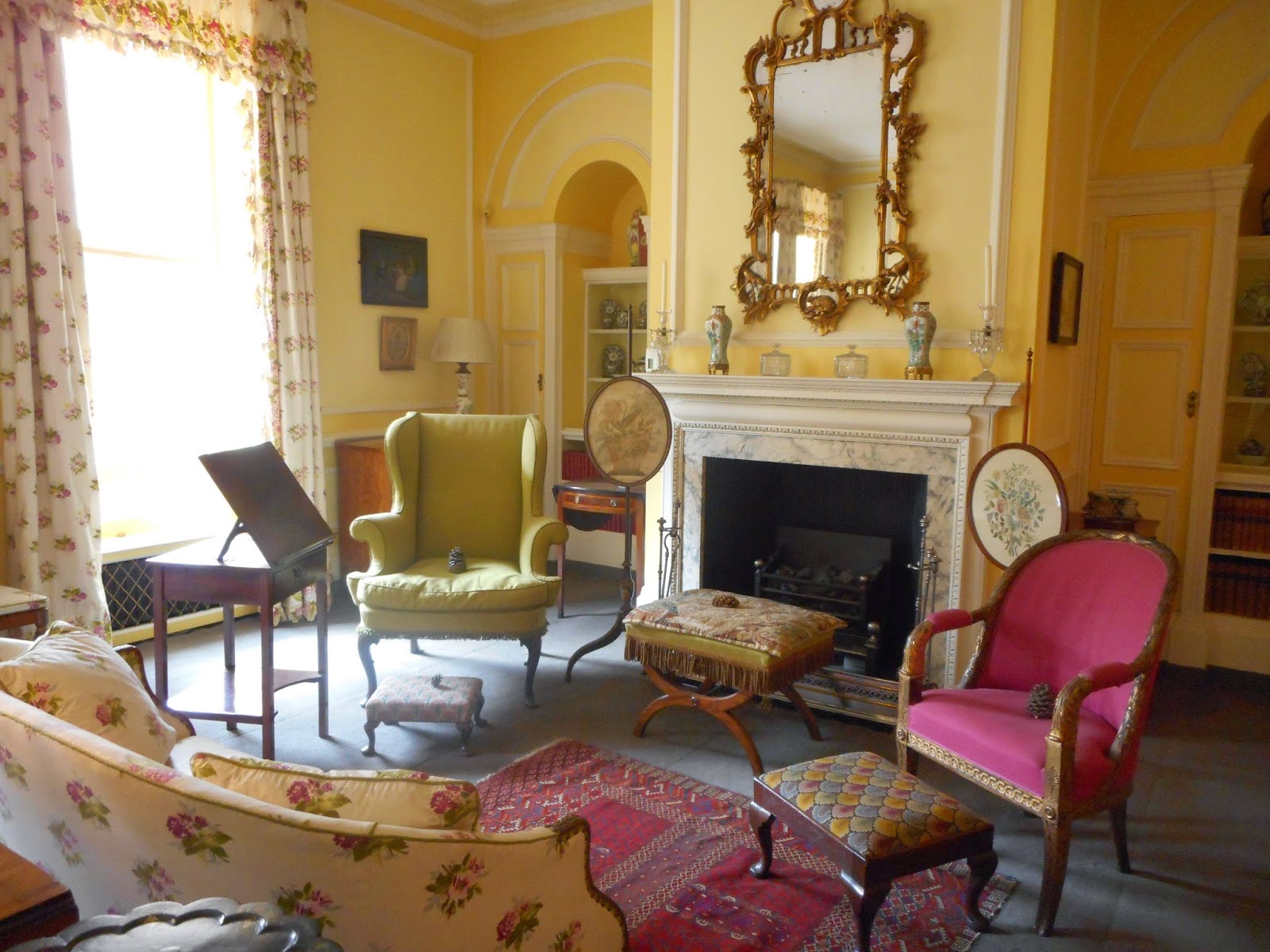
Fenton House is impressively large given the now limited space available up on the hill but of course it would have pre-dated many of the other buildings, built as it was probably in 1686. It has had innumerable owners and tenants taking a whole page in the National Trust guide book but I suppose they key people were the Fentons, after whom the brick-built family home was named, and Lady Binning the last owner, avid collector and benefactor to the National Trust in 1952. Most of the owners were stolidly middle class – merchants, lawyers even a gas engineer (to the Ottoman Empire no less). There are actually only eight rooms to visit on the two main floors and then six additional rooms within the attic space on the second floor, so while grand and with beautiful pieces of furniture you can just about imagine yourself living there…


All the rooms have generous windows with excellent views over front and back gardens which are of course maintained to a wonderful standard. The downstairs rooms, as you might expect, were used for reception, dining, the smaller as a library with the upper floor for bedrooms and more intimate drawing rooms.

Rather than itemise the displays in each room it seems more straightforward to look at the different collections.

The musical instruments from the Benton Fletcher Collection in the main were re-homed (it’s not just dogs you see) post war after their original habitat was destroyed. Loosely speaking they are of the piano family, so harpsichords, virginals and even a hurdy-gurdy and you can hear one here – quite folky though a little goes a long way… also lutes – as you are all better at this than me you can fit the names to the pictures!! If you visit PM some days there are skilled performers who conjure music from these pretty little domestic sized instruments, some very beautifully decorated and hand crafted out of fine woods.

The furniture in most rooms is beautiful, appropriate to the age of the house, well maintained   and delicate rather than heavy or obtrusive so there are pretty occasional and dining tables, a travelling desk, wickerwork chairs, and a range of glass fronted display cabinets though some of these are more recent and as a novelty contained electric lighting!


The most prolific collection is the ceramic one spanning both overseas and domestic items. Downstairs you will find the rather ‘frilly’ that is rococo style Meissen figures with the usual harlequinade characters though we warmed more to the down to earth butcher and letter writer. Upstairs were less finely finished English pottery pieces, Rockingham and Staffs varied. These included one of my weaknesses – cow creamers – and coming from a family of collectors I can see how a single (widowed lady) of generous means could fall into buying several examples of miniature sheep, cows etc. There are tea-sets too though of the grotesque rather than useful variety – in fact there is very little that is of a practical nature  and as Jo would say requires an army of domestics to keep it dusted.


There is also a floor to ceiling cabinet containing a range of blue Chinese pottery – we understood that the collection of this used to be even bigger but the better pieces went to the V&A. Compared to the rather busy figurines it is always soothing to contemplate a Chinese plate or celadon bowl…


Lady Binning whiled away some of her time doing tapestry footstools but the house actually contains a substantial number of fine tapestries – some original, some facsimile in her ‘re-created’ bedroom. The Stuart pictures, though faded are finely done, and blend in with the oriental themes.

The artwork is also impressive, most evidently in the Dining Room broken through to include the morning room (oh, we love a floor plan) where some-one invested in what might be loosely termed the Camden Town Group, an Edwardian era of more modest domestic paintings – in other words you can imagine them hanging in your own house as opposed to a grand gallery though of course the Tate has a very fine collection.  

Fenton House examples include Spencer Gore, several Sickerts and a lovely Duncan Grant though he does not quite count. I would guess the buyer for this house eschewed some  of the more urban paintings of buses and gasworks but we did enjoy Dame Laura Knight’s picture of ‘Woman Getting Dressed’: she might have belonged to the group had they allowed women in.


Up on the attic floor there are still ceramics to be seen but certainly the more interesting and venerable instruments are here – possibly at risk from both beetles and the breezes from the balcony.


Although when we were let into the house we were told the balcony was not open to the public as it was wet and therefore dangerous, when the curator spotted us he deemed us ‘sensible enough’ (little does he know)  to be trusted out on the small balcony which has a wonderful view. The Shard and other distant London landmarks are now a bit ubiquitous but  unique here was the opportunity to look over the walls of various grand (and regrettably empty)  Hampstead houses. This led to a shared heated invective against absentee landlords, speculative letting and overseas investors, who had little care or loyalty for local areas or community – a situation which is scarcely likely to improve. The whole ‘footprint’ of Fenton House is impressively large when viewed from above.


What had started with bright sunshine had within the space of a tube journey turned into a damp drizzly morning so we did not see the gardens at their best, but apart from some stolid gardeners we did have them to ourselves. The National Trust have of course worked hard on the restoration side of things and there is little more to say than the formal side matches the period of the house. Within it lies also a sunken garden which I am sure would capture the sun.

Through a gap in the carefully clipped hedges and cone shaped trees you can access the produce side – at least half of this is an old orchard and additionally the Trust have used young apple branches espaliered into a low fence; it will be interesting to see how this develops. Beyond that the vegetable beds were being assiduously prepared.


A devotee of any of the collections mentioned above could have spent longer lingering but we were very happy with the ensemble experience of Fenton House – why Fenton – well the owner who was a Baltic merchant (rather touchingly his daughter was born in Riga) seems to have had his name stick and who are we to argue two hundred years later?