Monday, 13 January 2020

The Number 77 Route


Waterloo Station to Tooting Station
Friday January 10 2020

Our 76 had left us round one side of Waterloo so we cut through the station, using the free facilities on the way, and located the T Bus stop (which I would have called slip road to South Bank rather than Waterloo Station.  There was a very muddy dusty bus waiting and when a much cleaner looking one drew up behind the first one and opened his doors, we got on as the only passengers.


It takes a series of roundabouts to get clear Waterloo, passing the Imax with the creepers gaining ever more of a hold on the circular cinema.  More venerable buildings look over the circulating traffic: the once Royal Waterloo Hospital for Children & Women, and St John’s Church .  More building on central plots is evident when you pass the Park Plaza hotel after scooting along York Road, where the Belvedere Gardens development may offer stunning views to the front (balconies overlooking the Thames and the Eye) but from the back have a rather oppressive impact on the road.

Some of this development was previously the UK headquarters of Shell, while the hotel next door was once County Hall – as the bus stop is still known.  Opposite is another former hospital whose history is well documented here and which is now also a hotel.

It’s good to know therefore that St Thomas’s and its Children’s Department at the Evelina are still functioning as hospitals and have not been turned into hospitality centres.  St Thomas’s has a long history in London and the Florence Nightingale Museum is worth visiting. 

Across the road some works on a church building slowed the traffic somewhat so we coasted slowly round Lambeth Palace and the adjacent Garden Museum, Garden Museum which I believe has had a makeover since we visited.  We believe the pineapples atop the supports for Vauxhall Bridge are there to remember MR Tradescant who imported many new species.

The Albert Embankment runs along a fairly straight stretch of the River looking very grey today... There are plans afoot for the listed building which was the former HQ of the London Fire Brigade but it all looked deserted today?


Jo was pleased to locate the small theatre ‘Above the Stag’ for which she had been filing programmes but before we could take any photos the bus had started its tour of Vauxhall – in order to enter and exit the bus station in the correct direction the 77 does a complete circuit of the unlovely (and difficult to navigate) Vauxhall one-way system.  Even there we gained few additional passengers.

The ‘new’ Covent Garden, which has been here for about 43 years is part of a huge regeneration project.  The rehousing of Flower Market, down the road from the vegetables, the relocation of the American Embassy (hence housing called Embassy Gardens) and finally the transformation of Battersea Power Station have all made Nine Elms an extensive building site but today’s excitement was to spot Nine Elms (tube) station, now nearly complete. 'What line is that one?' said Jo –' the extended Northern', I answered, which looks to be a deal more ready to go than the Elizabeth Line, although of course only it consists of two stops – this and Battersea Power Station, though there could be plans to link into Clapham Junction.


By now we were on the long straight stretch of the Wandsworth Road, along which there are two impressively large areas of social housing: Lansdowne Green and the even larger Springfield Estate, both wonderful 


examples of the grand scale and aspirational ideals of the then London County Council building homes for families. There are a few shops at this point but the numbers increase as we approach Clapham Junction; the Battersea Arts centre continues in the pretty former Town Hall and was showing ‘Goldilocks and the Three Musketeers’ a novel mash-up?  Clustered around are  more community facilities from chapels to police, and a generous sprinkling of pubs up to including the Falcon.


If you wanted to catch a train you needed to get off before the 77 turns left down St John’s Road briefly – we wondered how long this branch of Debenhams on the corner was going to survive.  Wandsworth workers were up on their mini cherry pickers removing the Christmas decorations so we squeezed past and right up Battersea Rise, always a slow ride as a narrow stretch of road that is both the A3 and the South Circular – ouch.

Still the 77 turns off in a SW direction, essentially the only route parallel to the railway, which is at first visible but then less so, for a long stretch past the more open area of Wandsworth Common . A stop named for Windmill Road led me to find out whether a mill remains – it was built as a pump for the railway which runs in quite a deep cutting and presumably was prone to flooding, which must still be a risk for this busy line.
(At this point we were driving directly into the sun thus rendering photography difficult)  


At the end of the common the bus turns down Earlsfield Road which is bordered by sizeable Edwardian homes with never a handy shop for the residents.  A couple of ‘ghost sings’ provided evidence of previous small newsagents but the locals will now have to head to Earlsfield or further away for their milk etc.  The 77 joins long Garratt Lane about halfway down and in time for other passengers to catch a train at Earlsfield Station, which forms the hub of local shops and pubs of all kinds.  We noted that the Sailor Prince pub had been reborn as the Wandle, after the river which runs nearby.  There is a theatre too, the home of Tara Arts which for more than forty years has been promoting the  varied culture of South Asia and now has a permanent home here.  The nearby and strangely named Hallowed Belly proves to be a pub with food, and then the shopping and eating opportunities peter out somewhat as Garratt Lane continues to wind its way down to Tooting passing through Summerstown struggling to maintain a separate identity between Earlsfield and Tooting.


I always think the cemetery and the nearby almshouses are near the end of Garratt Lane but in fact there a couple of stops to go and for once I was able to observe the street numbers which go up to 1085 – pretty high for an English road.


We had been somewhere between amused and irritated by a back seat passenger who was planning his weekend with a friend on the phone (though the friend did not get much of a look in) starting with going to bed later today, waking up at 10PM, going out then getting in at 3-4 AM, and starting again Saturday after a modest lie-in...  The 77 will be tucked up in its garage so he will have to take a N44 or the tube to keep those hours, but definitely not our problem.  Like most of the other passengers, he got off at the Broadway (where there is also a college) while we carried on down Tooting past Amen Corner to the altogether shabbier and less used Tooting Station.  We had been hopeful about a promised regular Thameslink service but hit a 19 minute wait on one of London’s more derelict seeming stations – not withstanding the mural.  Our journey had taken 10 minutes over the hour to solid SW London after all the novelties of Thameside buildings.


Friday, 10 January 2020

The Number 76 Route

Friday 10 January 2020

Today was going to be a really logical day as we were to go from Tottenham Hale to Tooting on two, consecutively numbered, buses.

Linda and I met at about 10.00, at Tottenham Hale, which is undergoing serious alterations, with new buildings going up all round, and of course, demolition going on as well.


It's being provided with a much better bus space than Euston or Kings Cross, though it's not quite sorted yet. There are no 'facilities' at the tube or bus stations, but you can find what you might need on Platform 4 of the Rail Station.


We headed out and left, and were very soon at Tottenham Town Hall and Holy Trinity Church.  This was built in the 1820s and, according it its website, was modelled by the architect, Savage, on King's College Chapel in Cambridge.
We also noted the plaque for John Williams, a 19th century missionary who died a violent death on one of the islands near Australia.  His plaque is on a cafe called The Post, almost next door to another, called The Blighty.  The name seems to reflect their commitment to the Commonwealth of Nations, rather than to the former British Empire.

The route continues straight, so we passed the College of North East London and the Catholic Church with the inspirational posters against knife crime which we have previously mentioned.  Stamford Hill was busy with shoppers getting ready for the Sabbath, and then we were at Stoke Newington Station


We also passed the handsome entry to Abney Park Cemetery, which is part of the Capital Ring and a pleasantly green place to walk through. By the way, the word cemetery, which seems a long way from Graveyard, or Friedhof, has its roots in Greek and Latin words about lying down to sleep, which seems appropriate.
We had noticed that Hackney had not yet removed all its Christmas Decorations, so we were impressed with the forethought shown by planting a large conifer on the road heading down towards Dalston, which can be dressed and undressed as the season requires.


The route passes into the very Turkish area of West Hackney, so we could admire the attractive mosque, as well as the enormous HQ of 'Beyond Retro'. Princess May Primary School is named for the wife of George V. who tends to be known as Princess May of Teck, that being the part of Germany she came from.


Not for the first time, we came through Dalston, passing its two Overground Stations, and its busy and vibrantly coloured market.  I was puzzled by the Inn sign of the Talbot Pub, which showed a dog with wings.  Talbots were hunting dogs (without wings) now extinct, presumably because there's not much demand for hunting dogs these days. It's also the surname of the family of the Earl of Shrewsbury: none of which explains the wings....


We next headed through the De Beauvoir area to reach and run alongside the Regent's Canal before turning left to cross it.  Here we paused for two minutes 'to regulate the service', which confirmed our view that we had had a very smooth journey so far. It gave us time to note the huge amount of new accommodation being built here as everywhere.


And then, of course, it is the road works at Old Street.  The 'gyratory' has gone, and traffic seems to be moving smoothly.  We were somewhat puzzled by the large castellated building we passed here but, of course, Londonist explains it all.

We came on down past Moorgate Station, getting ready for the persistently delayed Elizabeth Line, and past Finsbury Square.


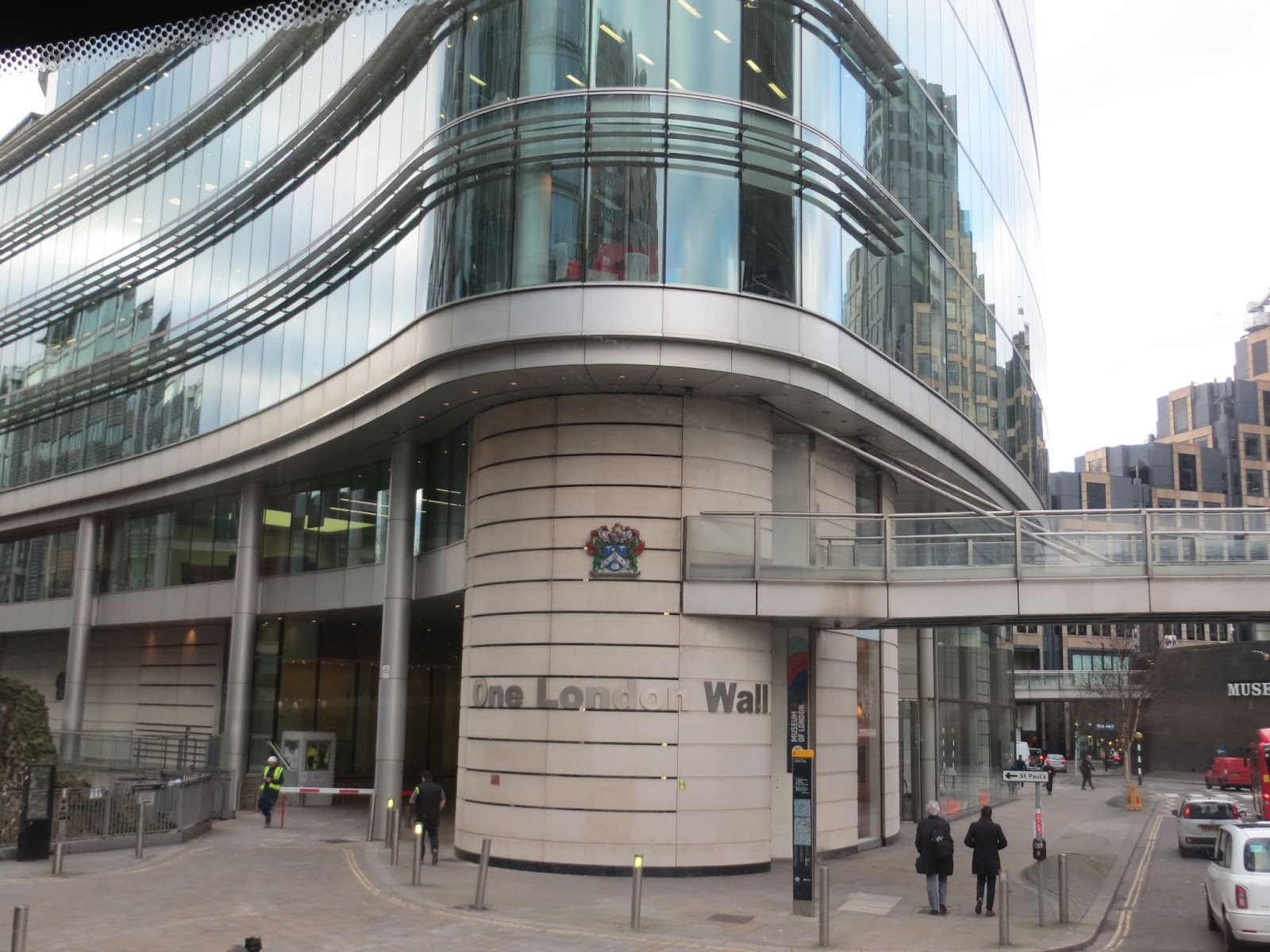
The Barbican, looms over this part of London, as does the about-to-move Museum of London.  We wonder what will happen to its extensive buildings when it goes.

We were interested to note that a bar at the Globe Pub was called 'Keats at the Globe' but it seems John Keats was born in the stables next door where his father was employed.
Down at the end of Aldersgate, and with views of St Pauls, we were delighted with the angels on swings which are a part of the decorations here.

Then we swung right to head past St Pauls and along a strangely uncongested Fleet Street.
Queen Anne is outside St Paul's because, although we tend to think of the new cathedral as a Charles II thing, it wasn't completed till 1711 (35 years is not bad for a building of this size and complexity, though)

As we came along Fleet Street towards the Strand, we noticed a small bust outside numbers 72-78.  Thanks to the modern miracle that is the web, I can tell you that this is of T P O'Connor MP, an Irish Nationalist.  I suppose he's along here because he was a journalist as well. We also passed the International Arbitration Centre, which proves to be a place where people can hire a room for mediation, or maybe just discussion.

Then we were past the former Aldwych (or Strand) Tube Station.  You can book a tour of the place, or just have a look at this website.  Among its uses during the Second World War, it stored the Parthenon Marbles from the British Museum.

The makeover at Somerset House seems to be taking a long time, but we were soon crossing the river, and nearing the end of our journey.


We came past Waterloo Station, and then did a long loop round the former County Hall to get back to the rather dingy end of Lower Marsh alongside the wall which screens the platforms.  We arrived at 11.20, ten minutes faster than the advertised length of this route.  It had been a remarkable North-to-South trip, and we had a short walk to get to our next bus, the 77.


Saturday, 4 January 2020

The Number 75 Route

Friday 3 January 2020

This, our third bus of the day, was waiting for us when we arrived, and set off from the Fairfield Halls promptly at 11.35. We went in a loop through what we take to be the 'Croydon Growth Area' and passed a number of new and pending buildings as well as some demolition works, to get back to the Fairfield Halls in the opposite direction.

We enjoyed some charming singing from the lower deck: two small girls inventing many new stanzas for 'the wheels on the bus' until they got to 'stop that noise, stop that noise, all day long' and became quiet.

                                    The route heads over the underpass, so we could see the attractive planting, and goes past the entrance to the Centrale and Whitgift Shopping Centre, which seemed very quiet on what might be expected to be a shopping day.


And soon we were back at the West Croydon Bus Station, which we had visited earlier in the day.  It's one of those stations where they play classical music, by the way, and our previous pause there had been soothed by Mozart's Clarinet Concerto.

Now we made our way through mostly residential streets, with new building everywhere, to pass the very trendy looking Quaker Meeting House, offering 'The Quaker Experience'.


Our way was enlivened by a few interesting sights: a bus shelter which had caught a large number of windfall apples; the Crystal Palace Football Club banners which line the road; Selhurst and South Norwood Stations, and a very nice public clock.

Our fellow passenger in the seat behind distracted us a bit as he was talking on his phone about how he was proposing to go to bed for four or five hours when he got home. Had he just come off shift, we wondered;  or from a party?

Much more helpful was a lady sitting in the other front seat who suggested that we look out for a small local landmark.  Suspecting that we might consider her as much of a geek as us, she explained that she was married to an archivist! And the landmark? Well, when the Goat pub was demolished, two of the ornamental goats' heads were preserved, and used to form the base of a bench outside the properties which replaced the inn.  You certainly need to have been warned in order to spot them, but we shall look out for them again whenever we pass this way.  


We also came past a cafe called the 'Daily Petit Dejeuner'
and came into Anerley, noting that the Mitre Pub was due for the same fate as the Goat.  We were interested to see a closed William Hill betting shop:  we thought bookies only ever multiplied in number.  Penge comes next, and then Sydenham; by now the intermittent rain had started again, so we needed brightness in our day: provided by the very pink Cake Store just past the Sydenham Centre, and a very purple 176 bus advertising the Lego Harry Potter Movie.


Now we turned left towards Catford, again through residential streets of varying periods and sizes.  Some of the trees had been heavily pollarded, so I was glad to know why thanks to the book that Linda was recommending on the 74 route post.  We were the only bus along here.

We passed the huge red brick police station (or possibly former police station) to join slow traffic crawling towards the centre of Catford.


A Chip shop called 'Oh My Cod' caught our attention, as did the bright colours and 'walk this way' signage of the railway Bridge, and we came over the Ravensbourne and into Catford.

We had a bit of a wait just next to the Cat of Catford, while our drivers changed.  The one we had started with had been a perfect gentleman, taking care about roadside puddles and splashing, waiting for slow arrivals.  The ride continued smoothly with the new hands on the wheel.


Lewisham has the 19th century Thackeray Almshouses on its High Street, as well as a Muslim centre, busy with people for Friday Prayers;  then we came past the large brick buildings of Lewisham Hospital.  The former public library has been absorbed into the hospital.

The traffic was again slow as we passed various landmarks:  Place Ladywell, the accommodation for street dwellers; the Watch House Pub.  The pub is named for Watch House Green, once a public green space in the middle of the village, where the lock-up was situated:  now built over, of course.


Saddest of all, perhaps was the old (Edwardian) Pool Hall, uninhabited for more that a decade but still not dealt with.  10 years ago a local church announced its intention of buying the building, but clearly renovation and repair would be very costly, not least because it is Listed. I think there is a conversation to be had about whether a beautiful building lying unoccupied and in need of anti-Vandal protection is actually that much better than what might replace it.
And that was it for today's outing:  passing the gigantic police hub, and grappling with the approach to the station known to us as 'where the roundabout and bus station were',  we got off our bus at 12.45, having had a pleasant tour of south east London.