Friday, 23 May 2014

The Nunnery Art Gallery, Bow

Thursday 22 May 2014

Linda and I headed East, to visit The Nunnery, as recommended by Diamond Geezer. (There, is by the way, a school of thought that suggests that one could live one's whole life just following his suggestions)

The day started with a sight hiccup, as neither of us had thought to look properly at a map, and the area map outside Bow Road station did not mention the place.  And Linda's phone (she is the modern one) was refusing to pick up the internet.  However, more traditional means of navigation proved effective - we asked a postal worker - as we soon reached the narrow alley that takes you to the Gallery.


At the moment, it is displaying artworks by the East London Group of painters.  Between 1928 and 1936, John Cooper worked with people from the East End.  He was helped by people like Walter Sickert (prolific artist and friend of Lord Beaverbrook) and there are several Sickerts displayed here.

But the real interest lies in the paintings by the East End's own artists.  Several domestic scenes, in varying styles are displayed, as well as a number of works derived from what we assumed to be art class outings, like the flamingo at the Bethnal Green Museum.


Then there are some holiday pictures, made at Herne Bay, Hastings and as far afield as Lyme Regis.  We thought the ventriloquist on the pier particularly striking, with that creepy feel that the dolls always have.

We very much enjoyed the pictures of local scenes, several of them familiar to us from our bus journeys in the area.  The Bryant and May Match factory, now rebuilt and rebranded as the Bow Quarter (where, by the way, you could buy a one bedroom ground floor flat for £320,000) can be seen as it was in the 1920s.

We liked the delicate lamp post in Harold Steggles' painting of Old Ford Road.  Several of his works have fine, wiry winter trees as well.

Albert Turpin's 'Canal Scene in Victoria Park' was one that I would happily have taken home.  The walk through Victoria Park (from - say - The QEII Olympic Park towards Angel) is one we enjoy.

The subtlety of the colours in Walter Steggles' Bow Bridge also took our attention.

All in all, we admired the pictures very much, and were able to enjoy them alone (which is rather a pity).  I suppose it is part of the strange way London is perceived by the rest of the country that there is a play about the North East's Pitmen Painters, while these Londoners are less well known.

The gallery is very easy to get to  and well worth a visit. The 205 bus would convey you from Paddington, or the 25 from Oxford Circus, even if you don't want to use the Underground or the DLR.


Tuesday, 20 May 2014

The Fashion & Textile Museum

Thursday  May 15th  2014
The Fashion & Textile Museum
79-85 Bermondsey Street SE1 3XF

Jo, Mary and I arrived on foot after a short if unscenic walk from London Bridge Station (having crossed all the lines at platform level you then have to skulk beneath them along Bermondsey Street) to find the easy-to-spot Fashion & Textile Museum. This is an area of London still full of narrow streets which used to be part of the leather and tanning industry, with the nasty effluent heading into the rivers, and which is gradually being rehabilitated and loved.


The Museum was set up by Zandra Rhodes, well known for her colourful Sixties and later designs and the exterior of the building reflects her colour palettes. There are those in the party (no names mentioned)  whom the word ‘Fashion’ might make run for the hills, but I am pleased to say that by the end Jo (oops) was wishing it was her turn to write an account of our visit. The exhibition was entitled  ‘Artist Textiles – Picasso to Warhol’ but contained so much more than the two named artists – essentially everyone you may ever have heard of (and a few not) had been seduced or persuaded into designing head scarves at the very least or dressmaking or furnishing fabrics at most. Jo took many photos and almost certainly I will have made errors in the captions so I will let you match artist to picture!!


The artists included :
Matisse (of course)
Sonia Delaunay – fabulous stripes and choice of colour
A Braque
Dufy – amusing and topical prints with variations of Charlie Chaplin or tennis matches – very Thirties
Leger
Ben Nicholson

Miro, and – the real revelation – Salvador Dali. None of us enjoys his work and indeed find it positively unsettling (I know that’s the point) but his textile designs were an enthralling and witty surprise. (This one is 'Number Please')

If all that Alexander Calder makes you think of is giant mobiles think again; he too ventured into textile design, though of a rather spidery and less attractive finished article.


Rather in the mould of   William Morris in the preceding century, several of the artists joined or started specific design workshops. The Bloomsbury Set started Omega Workshops and here were represented by a Ben Nicholson rug, to which any of us would have given houseroom, and a Vanessa Bell item.  There was also an example from the Wiener Werkstatte and into the Post war period Hammer Prints.
By the time we reached the post war period – late Forties and Fifties textiles were being used for frocks – eavesdropping on the many other visitors, entirely female it has to be said, these provoked waves of nostalgia for  Horrockses frocks and home dressmaking.  As some-one with the equivalent of  two left feet  where sewing is concerned  this is not a conversation I could join but I was still left admiring the clothes.
The more tailored and formal styles then give way to the vibrant colours and looser shapes of the Sixties: stand out items include Warhol’s ‘Happy Bug Days’ in two colourways – turquoise and orange of course – and his delightful melon prints. Again we had no idea he had designed so much and so well for both furnishing and fashion.


Less surprising were the contributions from Picasso, who was always happy to squiggle on a plate and sell it, whose fabric designs were taken up by an Apres-Ski Company of all things. His Mediterranean-inspired designs, and bull fight motifs  sit slightly oddly with anoraks and the like.


The last room showcased designs by Sarah Campbell , who has continued designing solo after the death of her sister Susan Collier – the board showed how artists build up colour and small details of design into paintings which then form the basis of a repeat pattern – quite inspirational.

I think this exhibition demonstrated quite clearly that there is no firm dividing line between Art and Design, and making their work available in a more accessible and possibly affordable way can only enhance the reputation of the various artists and bring pleasure to those who buy the end products.


This exhibition is about to end but future plans include exhibitions revolving around Mexico and Frida Kahlo, and knit wear design, and on the basis of today’s experience we would all be keen to return.  There is no permanent exhibition but a series of changing special shows. 


PS Steinberg's Paddington Station for anyone nostalgic for transport.


Friday, 16 May 2014

Interbus (Etna Transporti)

Taormina to Recanati, Sicily
Sunday May 4th 2014


Once a bus user, always a bus user.
This must be one of Europe’s more scenic routes.

Sicily is surprisingly hilly/mountainous and so was this bus route. It runs about once an hour to a time-table from the bus station just below the (largely) pedestrianised  town of Taormina.


The story behind Taormina is that the original Ancient Greek residents of Naxos, cosily situated down by the port on a lovely wide bay on the East Coast of Sicily, took the wrong side in a big battle between the cities of Athens and Syracuse so the winners, Syracuse, destroyed their fishing/trading town down by the sea. Not too beaten down, they headed up to a rock which was more easily defensible and settled in what is now Taormina, a very popular tourist destination for visitors to Sicily. Taormina has narrow streets, city gates at either end of a main drag and a large Greek Theatre so any buses have to stop short of the Messina Gate.   The rock that is Taormina is about 800metres high so the bus needs to descend very steeply….which is the fun part.


There is a kiosk at the bus station where they happily went on selling tickets well beyond the capacity of the single decker bus, so it was a case of first come first served, and some disgruntled would-be passengers booted off.

The slowest part of the bus trip is the initial descent from hill top Taormina via several spectacular hairpin bends down to beach and sea level.  The bus uses the road marked as SP10 on this map… If you crane your neck from the bus you can just about see up the steep rock face you have just descended. (on the non-cliff edge side is a Byzantine Necropolis) 


Once down on the level the bus speeds up a little – obviously there were few stops on the descent save for one in a ‘pull-off’ by the aptly-named Belvedere, from where you can descend on foot. [You walk down a series of 750ish steps which bring you to a beach with a short causeway (roll up trousers and wade at low tide) across to Isola Bella, a small island now a nature reserve belonging to Sicily.  It had been previously in private hands including a  rich English woman who planted her villa garden there with many imported exotic plants which did well in the mild climate.] The bus stops are a bit difficult to spot as more often than not sponsored, quite often by an underwear firm. London bus shelters sport often changing adverts but the stops themselves remain sacrosanct.

The next landmark, where a good number of passengers got off, was the railway station for Giardini Naxos/Taormina – the station itself is a very pretty Art Nouveau Building with splendid lamps and offers a service to Italy (train trundles on a ferry over the straits of Messina) in one direction and back to Catania the other way. Mainly the train runs on time.

The route continues round the bay of Naxos – unfortunately the bus takes a less scenic road round the back of Giardini Naxos, leaving the seaside route for commerce and strolling pedestrians. Giardini Naxos used to be a fishing village set amongst Lemon Groves; however tourists are now the main cash crop. Having said that the promenade is very pleasant; the rental flats and hotels are in the main low rise with a splendid range of restaurants at street level, these interspersed with those shops you only find at the seaside selling flip-flops, plastic balls and sun-hats.  On the other side is a modest beach and the sparkling Ionian Sea.


Reconati is further west along the Bay of Naxos and is really a continuation of the resort with the additional bonus of the roadside Archeological Park – more park than ruins and beautifully overgrown with a view of snow capped Mount Etna in the background.
 

After 30 minutes or so the bus comes to a halt behind Reconati main street – an end to end journey spectacular in either direction and at 1.90 Euros per adult single journey (3 Euros return) for a trip involving the kind of bend negotiating that you would not like to undertake in a larger vehicle a true bargain. 


Wednesday, 7 May 2014

Queen Charlotte's Cottage, Kew Gardens

Monday 5 May 2014

Actually, while were at Kew for the Bank Holiday, we also visited Queen Charlotte's Cottage, which is only open at weekends and for part of the year.

It's a cottage rather in the way that the Petit Trianon was a farm, but has some endearing insights into Queen Charlotte's family life.  George III gave it to her as a wedding present, and she used to take her family there for picnics and informal fun when even Kew Palace seemed too stuffy.

She added an upstairs floor to make what was known as the picnic room, and the trellis decoration was done by Princess Elizabeth, one of the fifteen (not a misprint) children of the royal couple.

The downstairs room is lined with floral and other prints, like those table mats that people get as wedding presents.

When we visited, the staff were wearing quasi Georgian dresses, but they did not need to say a lot as there is plenty of information, and not that much to see.  It is, however, free to enter, once you have paid to get into the gardens, and its position is delightful.  It is surrounded by bluebell woods, and there are oak trees which I think were planted by the Mayors of the different London boroughs some years ago, but I can't find the reference.

There is much more detail about the Cottage and its history on Rachel Knowles' excellent website.


Monday, 5 May 2014

The Shirley Sherwood and Marianne North Galleries, Kew Gardens

Monday 5 May 2014

The early May Bank Holiday, the sun shining brightly, the Overground working in the West, so what could be better than a trip to Kew?  The gardens were looking ravishing, but I am not about to tell you about the azaleas, the bluebells, the students' vegetable beds.  

Andrew and I did not think we had ever visited the Shirley Sherwood Gallery of Botanic Art, so we did so today. It is housed in a clean looking modern building and is free to enter (after you have paid to get into Kew Gardens, of course).  The displays are of paintings and drawings of botanic specimens, some accurate and scientifically detailed, some artistically arranged.  Many of them were so beautiful that they would sit happily on a domestic wall. Though watercolour and paper are what we were expecting,  some artists use oils on canvas. They ranged in period from quite old (after all, botanical drawing is a very ancient art form) to very recent, including several from an exhibition in Pisa, by Italian artists of the present day.  According to London Town website, the Collection has more than 200,000 pieces of work in it:  we enjoyed the few dozen which were on display. 

Attached to this exhibition is the even more remarkable Marianne North Gallery. It has a slightly 'Pitt Rivers' feel to it (if you have visited that Oxford Museum) in that every wall is covered with her botanical and scenery art works.  She was a 19th century biologist, who knew Charles Darwin, and travelled widely. She recorded what she saw and the plants she discovered, as she travelled around the world. Her works include flora all the way from California to Borneo and she spent a year in India too.  Then Darwin suggested she should make a further journey to Australia and New Zealand.  She always planned to leave her collection to Kew, and did so, before her death in 1890, aged only 60.  She had the advantage of coming from a prosperous family, but that fact does not make her any less intrepid or talented.

There is so much to see at Kew that I did not think Mary and Linda would mind my visiting these charming galleries without them. If they do, I shall be only too happy to go back again.


Wednesday, 30 April 2014

The Cubitt Studios and Gallery

Wednesday 30 April 2014

Having missed last week's outing, I enjoyed a lone trip this week, both Linda and Mary being busy.  I made my way to Islington Mews, a tiny and unpromising dead end off the Pentonville Road near Angel.  Unlike many of the museums we have visited so far, the entrance is not impressive.  But a press on the bell produced a nice young man who pointed out that the plant pot was also a cycle rack, and asked me too close the door behind me when I came in.  I noticed when I left that the door has fierce labels saying 'do not slam the door' and 'do not touch the scaffolding pole' which may say something about the stability of the building.

The Cubitt complex is mainly a set of studios for artists, but there is also a simple two room Gallery.  The pictures come from the Cubitt website as I did not feel it appropriate to wield the camera in a gallery space without permission. 

The current offering is called 'The Shape of a Right Statement'.  It takes the form of two screens, one small and one large, showing monochrome 'home movies' of the American artist, Cynthia Maughan.  She tries to adjust a scarf to hide the marks on her neck;  she displays a coffin made out of 850 toothpicks with a shrouded skeleton inside; there is a man standing by an open refrigerator.  Then there is a long sequence about a blonde femme fatale. And so on.  The smaller screen, also black and white, showed hands administering a dose of liquid from a medicine bottle, as well as a charming interlude called 'what if the sun fell on my corral'.


The information sheet explains that these works are 'returning to a non-linear understanding of survivalism and fascination between sincerity and manipulation'.

I was the only person in the room for the 20 minutes that the loop took to run;  I also had a look at a smaller TV screen.  Again, I need to refer to the notes.  The artist, Wu Tsang 'seeks to insert a question mark into notions of authenticity, and the intention of the speaker.' The way he does this is by producing the words of the autism rights activism Amanda Baggs, who can be seen here.

OK, I admit it:  I was baffled by the whole experience.  But it was interesting, in a baffling kind of way, and I shall watch out for other exhibitions at the Cubitt Gallery, to see if  I get a better grip on the next one.

Tuesday, 29 April 2014

All Hallows

Byward Street EC3R 5BJ
Thursday April 24th 2014

This visit was to provide something of a contrast to the Gold of Mammon that had been our previous visit, to the Bank of England Museum.  It is not a very long walk from Bank, essentially a gentle eastward incline though it is not advisable to dawdle on the comparatively narrow pavements of the City of London as you may well get shunted aside by someone in a hurry.
We did not really know what we were looking for but the church is a sizeable edifice that seems to stand on a kind of island on Byward Street very close to the Tower of London. You really cannot miss it.  I was doubtful about who could form part of the congregation of such a church, there being a distinct shortage of local homes, but once inside the distinctly rebuilt interior it seemed clear it is still quite a lively local church offering itself as a sanctuary for ‘city workers’. Certainly the Kitchen, which is the church’s café, smelt most appetising and has an entrance straight onto the plaza area which fronts the modern glass building. During our visit the Organist / an organist was having a practice for a scheduled lunch-time recital,  which added to the atmosphere. 

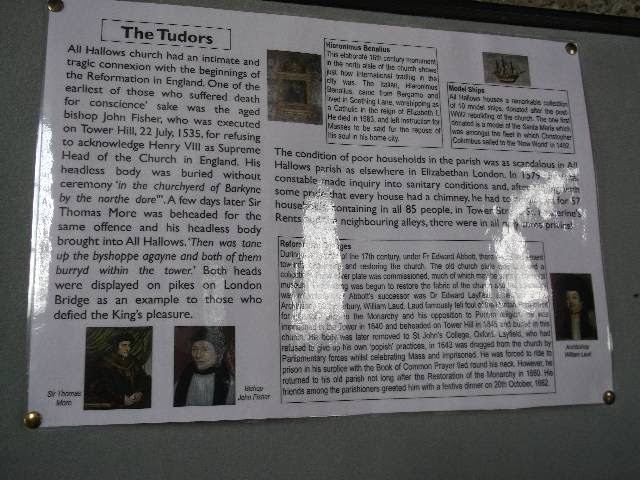
The Church claims to be the oldest in the City with origins going back to Saxon times, the Arch for example, but due to some inexpertly kept gunpowder sacks the whole building went up in a boom just in time to be rebuilt in a post Reformation style, with a sturdy brick tower, to survive the Great Fire of 1666; in fact Pepys climbed said tower in order the better to observe the extent and progress of the fire. The building fared less well during the Blitz and was badly damaged, hence the somewhat bland interior. However there are plenty of artefacts to keep one’s interest and to warrant it counting as a Museum as well as a place of worship. There is a strong Maritime theme with several ship models hung on the walls, a dedicated chapel and a ship’s bell from a recent shipwreck.

The font cover is displayed behind a grille as it is a beautiful piece by  Grinling Gibbons. Here is an artist whose key works have to be seen where he completed them, and this one seems to soar towards heaven.

If you can manage the few steep steps down to the crypt there are other treasures on display – it’s a charmingly mixed bag which somehow summarises the history of London – a tessellated floor complete with drainage channel from a Roman home and a glass case of that strongly earth coloured Samian ware and some burial plaques – the light was a bit low to decipher the (Latin) text.  Unusually (because many of these artefacts, if not destroyed in the Reformation, definitively went during the Civil War) the church has a lovely carved alabaster plaque, which apparently was stolen fairly recently but recognised and returned.

The church’s registers – impressive ledgers – are also displayed to show that William Penn was baptized here and another book certifies the marriage between Samuel Adams  and his wife.  These US connections have ensured periodic sponsorship of different restoration or building projects.


As ever we could have lingered longer and certainly the church offered not only a welcome contrast to our earlier visit but also to the bustle of tourists heading for the Tower of London.