Wednesday, 7 December 2011

The Number 260 Route

White City Bus Station to Golders Green Station
Monday February 28th 2011

This was the second bus of a 4-bus outing and to set off involved little more than crossing the road into our very favourite bus station, the White City (Westfield) hub. Spacious, well set out gleaming aluminium and friendly operatives had all been our previous experiences but this time we barely drew breath as the 260 whisked us off and out. In retrospect this was perhaps the high spot of a route on which various factors – cold damp weather, poor visibility, dirty upholstery (nameless brown stains on the seats) and no heating, doubtless compounded by hunger – gradually rendered the trip less than joyous. And we had started the day so well!

The 260 travels round the outside of Westfield West, past the gleaming station and then round Shepherds Bush Green which is actually quite considerable but today looked more like a mud bath than a green.  There could also be no greater contrast between the gleaming and sanitised shopping centre and the run down though quirky diversity of the Uxbridge Road.
We often travel through places on Monday when markets are not open but this one proved the exception.

For shop choices along both the Uxbridge Road and Old Oak Road we thought you might like:
Guava Jelly
Ambrosia Bakery
The Curtain Mill
The Nut Hatch
interspersed with pubs like the ‘British Queen’ and ‘Princess Victoria’ (little did they know how long she would reign when they started naming pubs after her! 

Rather to our surprise after these lively roads we suddenly hit Westway (also known as the A40) at the grandly named Savoy Circus, merely a junction. So after urban crawl we were speeding (for the only time en route) along a 3 lane dual carriageway mainly lined with residential streets, except for a stretch that was weedily overgrown and looked as though it should have been a canal or railway? Research indicates that though demolition happened the promised rebuild never did.
This part of London, with Acton Mainline so clearly established on what was once the Great Western Railway, celebrates the engineer Brunel, mostly in its university but also in road names round here – and there is no shortage of bridges that we crossed. Most memorable was Abbey Road (NOT that one, see the 139) over the Paddington branch of the Grand Union, thereby indicating that all modes of transportation can continue to exist side by side. 

By now we are quite familiar with this approach to the Central Middlesex Hospital, past the older bits of Park Royal. Just opposite the giant Asda we spotted some street art – not quite as grand as the bench in Bond Street where you can sit beside Churchill and Roosevelt, but obviously comfortable enough for some. As we waited for the lights we watched this man strike and discard most of a box of matches to no real effect.

If this was the Central Middlesex Hospital can Harlesden be far behind? The roads remain narrow and crowded round here and progress is always slow, today further hampered by rain. Not surprisingly lots of passengers got on here, so none of us were best pleased that after we had manoeuvred our way round Harlesden and the bits of Neasden that are bordering on Willesden we were turfed off the bus at Willesden Bus Garage. We have no objections if the drivers change over but it seems a bit churlish to withdraw the bus itself, An alternative 260 was lurking so we boarded (not able to get our usual front seats of course) and noted it was both cold and dirty too! Even peppermints could not save the day. Nor did the distant view of Wembley lift our spirits.


This 260 edged its way along the High Street towards Willesden Green, and it is difficult to believe that the roads back are really very nice. You can pretty much take your pick of religions round here with churches still as churches and others now mosques.   Dotted amongst the fast food outlets (Filipino Asian Store anyone? or Russian 'Magasin'?) was an interesting looking architectural  salvage store.

Given the slow progress elsewhere it was cheering that we crossed the Edgware Road pretty quickly so that we could head on north and a bit east through and up the pretty steep Childs Hill (the view is excellent if you are heading the other way as we have done!) to join the Finchley Road and a slew of other bus routes heading into Golders Green Bus Station.

Normally we are quite positive about this hub – me for nostalgic reasons as it usually marked the starting point for the Saturday and Sunday outings of my mis-spent youth, Jo because it’s on the Northern Line, both of us because it has reasonable toilets.  Not today: they were having a refit so we had to leave the station and come back to tussle with our next route – but that was a story for another day. 

Just to be picky again – Shepherds Bush Green, where we started was indeed a wide expanse of green whereas both Willesden and Golders appear to have lost their green grassy stuff and original claim to fame. 

Tuesday, 6 December 2011

The Number 259 Route

King’s Cross Station to Edmonton Green (Bus Station)
Wednesday March 24th 2010


This was the middle bus of a 3-bus outing and took us to our furthest point north for the day – the day being the one when the ladies who bus had a male escort (related) to accompany them. He was in fact appointed as the official photographer but unfortunately even the upstairs of this bus was so crowded he got wedged mid-bus which rather cramped his and our style.

The bus’s popularity can only be accounted for by the fact it heads due north with few detours offering basic shops for most of the length of the route, with few other distractions on a weekday.

We left the bus-heavy territory of King’s Cross behind us to follow the Caledonian Road (Scots wha’ hae) passing over the rather pretty Thornhill Bridge,  which crosses the Regents Canal. The locals prefer the name Cally Road hence the Cally Pools en route, not so far from another kind of baths – the Safi Hamam though unfortunately this is just a shop front for a beauty parlour not quite the extensive Turkish Baths its name suggests.  This stretch is often busy with chaps on scooters doing ‘The Knowledge’ based at the nearby Taxi Training headquarters – more power to their elbows, the rest of us having moved on to Google Maps and Satnav.  We are now more experienced travellers than when we started so we know this is a 2-prison route, but is not unique in that. First comes the fairly classic white Pentonville, followed by the recently rebuilt red-brick Holloway.

Alongside the railway lines, of which there is no shortage hereabouts, we spotted what seemed to be an interim depot for compressed rubbish being dumped by Veoilia vans, presumably destined for landfill somewhere not too far?  

On a more appetising note, a green plaque commemorates  Carlo Gatti, Swiss Italian ice-cream entrepreneur and good for him – the canal must have helped with distribution and the Canal Museum has taken over his former premises.

There is density of housing the length of this route which means most of the high street small shops and takeaways seem busy enough serving a diverse population – the Alban Deli and Alban Travel indicate a group now better established in London, as does the Addis Ababa restaurant. Hackney is trying to improve and signs indicate:
”This site will be delivering more affordable housing for Hackney’. Longer established are the City of London Corporation flats and estates, which always look that little bit more robust and better designed than the local council’s efforts. The same might be said of the large Woodberry Down Estate conceived in the 1930s but built post war in an attempt to offer affordable homes to thousands. Having visited family friends there in the Fifties I know the flats with their open walkways are spacious and solid.

I guess what was missing in the grand plan for this area was much open space – so much so that the very small Manchester Gardens impresses as a welcome oasis. Up and down the Seven Sisters Road is where the bus really filled up, even though it is far from the only route hereabouts. What’s more the 259 and others run pretty much in parallel to the Victoria line at this point but there was still no shortage of passengers. Through Tottenham there were a range of things on offer – the Bernie Grant Arts Centre , CONEL (the College of North East London), the Christ Apostolic Church with its LCD display, plus Town Halls, some in use, some not. Bruce Grove, actually a train station, has a very eye-catching market in its precinct and always looks busy. As well as offering two prisons, this is very nearly a 2 football club route: having passed the Gunners shop earlier at Finsbury Park Station we then had the Spurs Shop with the White Hart Lane Stadium (not one of the more iconic venues architecturally speaking) hard behind it.

For some reasons the male hairdressers/barbers seem to win out round here and we passed, not necessarily in this order: OBOYZ, CUT’Z and MR KLASS

Once out of what our Gooner children would consider enemy territory, Sainsbury’s seemed incredibly keen to get our custom, exhorting us to ‘Turn Around’ at several points along the straight route up from Tottenham to Edmonton. Also conspicuous was the pub The Gilpin’s Bell’ causing Jo to launch into a very impressive rendition of a William Cowper poem she had to learn by heart as a punishment for schoolgirl naughtiness. ( All 63 verses?)  The link will get you the whole text but the brief version is that as some kind of 20th anniversary treat Mr and Mrs Gilpin set out from home and the drapery business in Cheapside for a jaunt in the country at the Bell at Edmonton (sic) but given the cost of liquor Mr G. opted to take his own, strapped to his waist, and this combining with an unreliable mode of transport (a horse) the simple expedition soon ran into trouble.

Just short of our destination we had a little excitement of our own with a dust cart that was occupying the bus stop but all was amicably settled and just on the hour expected, we wheeled into the nicely canopied Edmonton Green Bus Station with a chance to admire their war memorial. This is one of those historic rather than actually still green-grassed ‘Greens’ but with signs to Picketts Lock and the Lea Valley I suppose that’s reasonable.

Not the most enthralling of trips but with more novel features towards the end.

Monday, 5 December 2011

The Number 258 Route

Monday 14 February 2011

First, I need to apologise to Tim:  I assured him at the weekend that there was only one London bus to Watford, and that was the 142.  Write it off to old age, Tim, because here's the other....

We (Linda and I) had only a brief wait at Watford Junction Station after we arrived on the 142. These are the only two ‘London’ buses to visit Watford, so it seemed worth linking them together.  Having seen a single decker 258 we were delighted to find this was a double decker, and settled into the upstairs front seats at 11.50. We noted the distinctive livery of the London Overground on the railway bridge, a more cheerful sight than the several empty office blocks in the area.  We headed back down Clarendon Road, and along Beechen Grove, noting that Watford Market was not open on a Monday, and the back of Charter Place was looking very gloomy though clearly the Council has been working on improvements. 
 Then we were down past Watford High Street Station, logoed for the Overground, and Watford Museum formerly Benskins Brewery Offices, but now a good quality local museum, which we hope will have survived the cuts by the time you read this. 

Down at the Water Lane Roundabout we noted Geo Ausden, the metal recycler  or as we elderly people used to say, scrap dealer.  Jo wondered if she had taught the firm’s daughter, but could not remember whose set Lisa had been in.

We popped round a roundabout to call at Bushey Station, with its clock,  passing Thwaites, where Rachel’s violin used to be serviced and also the Oxhey Messy Church which we found puzzling not just because of its name, but because we were not in Oxhey.  But it is simply the name given to a group of churches that seems to have some fun stuff on its website.  Then we were past what is now the Bushey Academy, a school which both Jo and the bus stop remembered as Bushey Hall School, and a blue plaque for Lucy Kemp Welch who lived in Bushey while she painted, mainly horses. I expect she would have enjoyed the crocuses  as much as we did.

Up through Bushey, and then right along the side of the common, where we were the only bus, we reflected on how prosperous green belt housing always looks.  Had I known that signs to the Grimsdyke Hotel would have led to the former home of WS Gilbert, I might have leapt off the bus, but I didn’t, which may be as well, as the website    has a strange reference to ‘the infamous’ Gilbert and Sullivan, which might have caused breakages if we had had coffee there.
At this stage we were joined by a number of students from Weald College as we headed to Harrow Weald, where we had been the other week on the 140.  This time Linda was able to capture the charming violin playing mouse outside the Italian Restaurant.

As we went through Harrow, it all seemed very familiar:  the handsome mosque, the dreary exterior of the St George’s Shopping Centre, and the peculiar golden woman by the bus and train station.

We were saddened to notice The Fat Controller Restaurant closed down.  No doubt, by the time you read this, it will be something entirely different. (actually, we were there just a couple of weeks ago and it is still 'not in service' as we bus users say)

Next,  we headed up Harrow Hill to see what can happen when a good man tries to help the poor boys of his area. Here is what the terms of John Lyons bequest intended:

In February 1572 John Lyon, a yeoman of Preston in Harrow, secured from Elizabeth I a charter to re-found a free grammar school for the boys of the parish of Harrow, to send two scholars to Cambridge and two to Oxford, and to improve the highways between Edgware and London. These intentions were amplified by Lyon's 'Orders, Statutes and Rules' (often called his will) drawn up in 1591. The schoolmaster was to be at least an M.A. and the usher a B.A., with salaries of £20 and £10 respectively, which were to be increased to 40 marks and 20 marks if Lyon left no heir. The schoolmaster might also teach fee-paying 'foreigners' provided that this did not adversely affect the children of the parish.  (http://www.british-history.ac.uk/)

Harrow School’s website is rather quiet about fees, but it seems safe to imagine that they are not less that other private schools of the same status, ie between £20,000 and £30,000 pounds a year.  Sorry, local poor lads of Harrow, clearly John Lyons should have tightened up his instructions when it came to those fee paying ‘foreigners’.

Please excuse the rant.  

Well, we then glided down the hill, and soon reached South Harrow Station, where the poor design of the access roads made it hard for the buses to manoeuvre.
We got off our bus at 12.55, just a bit earlier than the predicted time, and climbed straight onto our next bus, about which you will be able to read in a couple of years’ time when we reach the high 400s.

The Number 257 Route

Tuesday 23 March 2010

Linda and Mary were both busy today, so it was great to have Jenny with me.  Thanks to early 'dropping-off-at-nursery' duties, we met at Walthamstow Bus Station at 09.00 and were on the 257 and on our way to Stratford shortly afterwards.  Down Walthamstow High Road, I finally understood why Funeral Directors so often have corner plots:  so that the vehicles can get in the back with their cargoes, and without disturbing the bereaved entering though the front.  It may be obvious to my readers, but it hadn't previously occurred to me.

There were daffodils in profusion along Lea Bridge Road, but the lakes and trees we passed later were still very wintery.  We saw the 6/8 (Inns of Court and City Yeomanry) TA Signals HQ,  and then a number of cars parked in the layby indicated that we were near Whipps Cross Hospital.  We were the only bus along Leyton Way, and admired the Sir Alfred Hitchcock Hotel so called because he came from the area, though this was not his house.


The huge roundabout with the A12 has amazing cycle and pedestrian tracks within it, under the roads, which was as well, since some of the on-road cycle markings in the area were frankly hair raising.  

We twiddled round the one way system of Leytonstone High Street to visit the bus station, next to the Tube station, and there, to our surprise, were hundreds of people waiting. 

Clearly something had gone wrong with the Central Line.  They poured onto our bus;  then the driver announced that the bus would not be moving as it was overweight, so they all poured off, and it became clear that the trains were moving again.  They all flooded back into the station and we went on our way after a 10 minute pause.
  On past the church and a couple more corner Funeral Directors, as well as the 'Loaded Dog' Pub.  As usual, I can find details of its fame as a music venue, and information about the threat of closure, but no explanation of the name.  There are lots of Caribbean eateries in the area, as well as an Eel and Pie House.  The Plough and Harrow boasted a heated beer garden, bad news for the planet, though good for the smokers.  But the most exciting pub we passed was the Cart Horses, proudly labelled 'The Birthplace of Iron Maiden' a rock band even we of the Elvis (or in Jenny's case, Beatles) generation have heard of.

Shortly afterwards we rounded St John's Church, Stratford and, with views of the building works for the Olympics, reached Stratford Bus Station, a mere 50 minutes from Walthamstow.

The Number 256 Route

Thursday 16 November 2011

Noaks Hill to St George’s Hospital Hornchurch

We walked round the corner from our previous bus to the busy Noaks Hill Road, and waited outside the Bear Pub, apparently once known as the Goat, but here since the 18th century.

Linda and I were on board by 13.10 and heading down hill, with countryside on our left (including horses grazing, always a pleasure to Linda).  We passed the Pomapdours Pub, and speculated whether it was named for the hairstyle or the 18th century courtesan, but have since failed to discover any answers.

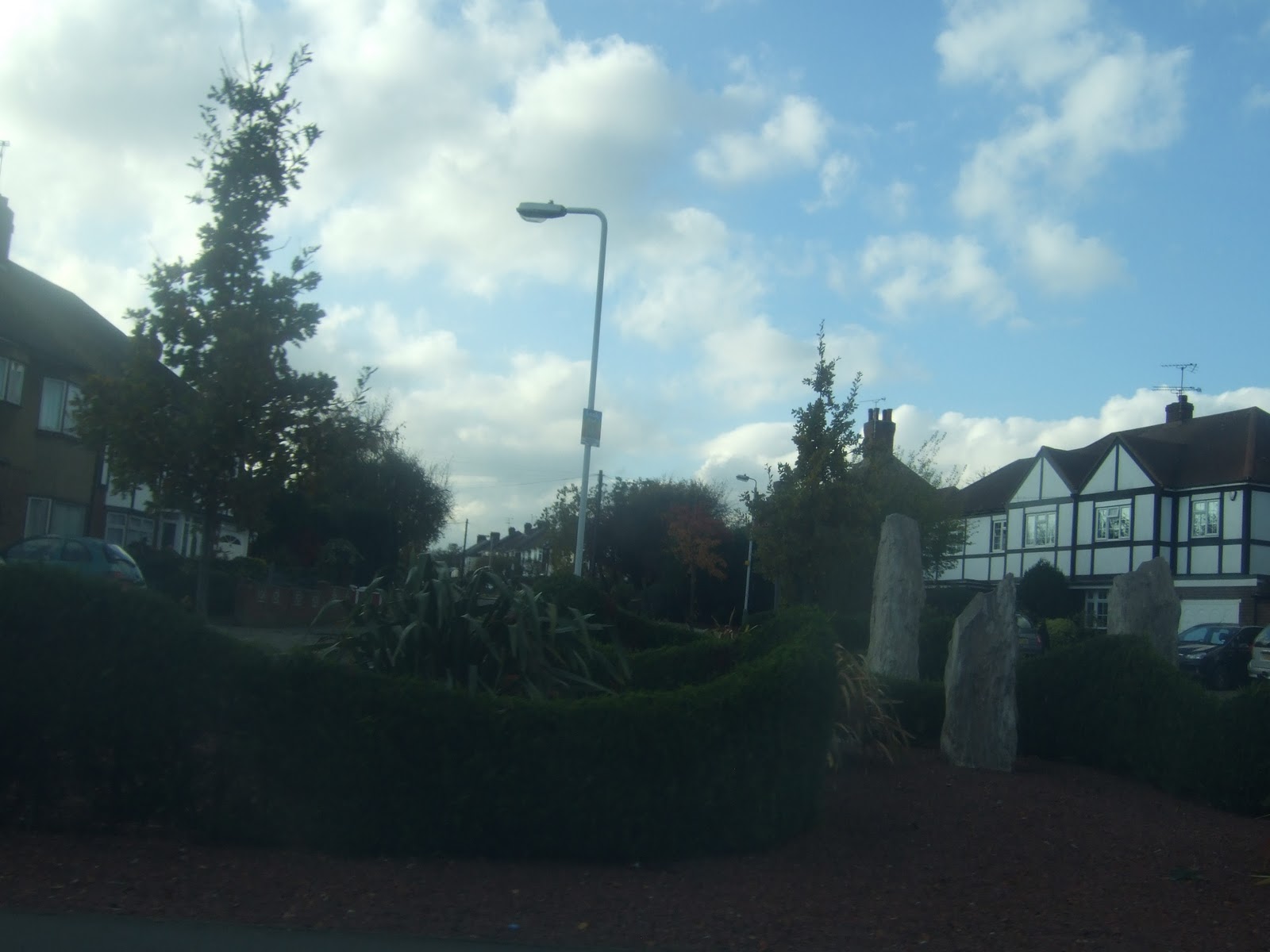
This brought us into Hilldene, and part of Harold Hill, embellished by a roundabout with standing stones. We have noted before that this part of East London has adapted its planting to the possible drought consequences of climate change.  There has not been much rain lately and we thought they were looking rather good.

We paused briefly in the forecourt of Harold Wood Station before continuing our journey through the pleasant housing estates, built, we think, to house people  being relocated in the later 1940s from bombed South and East London.  If this is the case, it would help to explain the startling number of care homes and ‘sheltered living’ complexes we passed.  We were, it must be said, rather surprised to see one being built for the Over 55s, at a time when people will be working until they are 67 or 68.
Very large houses were interspersed with bungalows, and we noted again what a great  year it has been for pyracanthas. Students got on and off as we passed Havering College. 

 There was a lot of traffic on the Southend Arterial road but fortunately our crossing point was controlled by lights so we were not held  up.  After passing a large Mormon Church,  we reached the outskirts of Hornchurch, with its ‘Oh My Cod’ chip shop (no, I am not making an connections there) and then made our way through the town. 


 We noted  that Elly’s Couture offered clothes for ‘Proms, Weddings, Races’ but deduced that this meant for Ladies’ Day rather than actually riding or indeed running.  We had experienced the road works of Hornchurch earlier in the day, and passed the plaque for the heroic boy seaman Jack Cornwell (see Linda’s account with the 252 early in November and also here) but this time we swept on past the station, to reach St George’s Hospital at 13.45 after a pleasant 35 minutes.

This had been a neat day, starting and finishing in Hornchurch, with a little loop around some of South Essex’s residential areas in between.

Sunday, 4 December 2011

The Number 255 Route

Streatham Station to Pollards Hill 
Tuesday  January 4th 2011


Mary, Jo and I had walked up Streatham High Road from St Leonard’s Church thinking a bus advertising itself as starting from the station might lurk alongside the rather modest Streatham Hill station but in fact the stop is opposite. Streatham of course is well provided with transport, having three mainline stations and at least 12 bus routes, so not surprisingly we are frequently visitors to these parts.  (However today we experienced a frisson of anxiety as we spotted that the Route 159 appears to have altered its route since we rode it last year – See Addendum to 159 posted late March 2011.)

Streatham was not very busy and clearly the driver was trying hard not to get ahead of himself so took the route very gently though there were in fact few boarding passengers until past Streatham Common. Streatham Station, equally modest to its uphill counterpart, is now totally dwarfed by a large Morrisons store, but the Baths are no more having been closed due to ‘structural issues’.  Ms Redboots has kept us up to date with plans for a much hoped for replacement Leisure Centre… Given swingeing local authority cuts it would seem lucky for this end of Lambeth Borough to be getting such a renovation or replacement, pools being expensive to build and maintain. The Ice Arena, which is a private venture, seemed still to be thriving, and is one of the few indoor such facilities in London…(due to close later this month.. see her comment on Route 250) On the corner opposite Streatham Common is the very simple but effective war memorial that was built mid 20th century and always stands out on this major bus and car route into London, originally of course a Roman route up from the coast. 

As we continued, south Streatham blends into Norbury, which is where most of the passengers got on, as round the station are clustered shops, take-aways and a bank or two. We could not quite see what was going on but there were crowds both inside ad outside the bank with a certain amount of police crowd control? Shortly after this, about the only excitement on this repetitive route, we turned right into Stanford Road and the heart of residential Norbury. Lots of pebbledash - what can I say?

Jo and I were trying to guess the ages of the homes round here: given none or few have garages or off street parking, they must predate the era where everyone was expected to have a car sooner or later.  Wikipedia suggests the London County Council built 500 homes in Norbury between 1906-1910 but I think the generous application of pebble dash is a better indicator and these homes are likely to be from after World War 2; the other clue being that the rows of terraces are fairly unbroken therefore post dating bomb damage. 

Pollards Hill itself, where this and other routes terminate, has more recent developments including a Harris School (they are dotted all over South East London and most in very new buildings) and next door heath centre. It was here of course that the passengers got off having completed their morning errands.

The bus completed its short journey in little under 25 minutes, with only the last quarter or so of the route offering much novelty.  

PS Few photos from this trip so have added a couple of Montage shots; also Lego London though little of that shows South London – I wonder why??
PPS Several routes to follow this week.

Friday, 2 December 2011

The Number 254 Route

Thursday 1 December 2011

I was rather puzzled last week to discover (courtesy of a comment about the 253)  that the 254 was once part of the same route. I had not imagined that the route from Aldgate to Holloway could have anything to do with the bus from Camden to Euston which we so regularly take.  Indeed, I pictured a northward journey from the start, a bit like the 17. Well, that's what this project is about: opening the eyes of parochial travellers to how the town knits together.

Linda and I met at the little bus station opposite Aldgate tube, and were onto the 254 just before 10.00.  With fine views of the city, we headed not North, but East.

Our first landmark was Aldgate East Station, with a blue plaque to the poet Isaac Rosenberg.  It's apt that his plaque should be at the Whitechapel Gallery, since he had hoped to become an artist, instead of being remembered for ever for the 'droll rat' and 'the parapet's poppy'.


We hurried on eastwards, past many banks but also small clumps of terrace houses, which had clearly survived both the Blitz and the developers.  We were following the line of the so-called Cycling Superhighway (CS2) as it makes its lethal way to Bow Roundabout.  I could not help thinking that it was perhaps appropriate to have an ambulance parked alongside it.

 We passed the stylish and substantial East London Mosque as well as the Jagonari Women's Centre, and continued east.  As we reached the Royal London Hospital and the memorial to Edward VII opposite, I really did wonder if we were on the wrong bus. The former Albion Brewery looks rathe shut up now, though still a fine building.

And now at last we turned north, or left, up Cambridge Heath Road, to pass Bethnal Green Gardens and reach Bethnal Green Station, scene of one of the worst events of London's Second World War experience.  On a more cheerful note we passed a convenience store named 'Offie and Toffee', which amused us, and then came to the Museum of Childhood.  There is little that brings on the Schadenfreude in a former teacher better than seeing a school party about to enter a museum, but there is such a lot to see and do there that I was sure the behaviour would be impeccable.


Soon we were out of Tower Hamlets and into Hackney, where we approved of the borough's signage, and also remarked upon the amazingly narrow Old Ship Pub.  We assumed that it has a more standard sized entrance on another street, as indeed it does.

At Hackney Central we did indeed pick up the 253 route, and we alternated with them for the rest of the journey.  We noted that the Lord Cecil Pub still has its picture of Lord Burghley, though it has been closed for some time and is clearly the subject of local debate.  We passed Clapton Ponds, and then Clapton Common, which also has a pond, and spotted a police van with the strapline 'convictions that stick'.  There were serious roadworks in Stamford Hill, and were were held up for a good ten minutes, occasionally glimpsing fine views across the Alexandra Palace.

As we passed through the Woodberry Down Estate, which is being regenerated, there came the message we like least:  that the destination of the bus had been changed.  It was going to terminate at Finsbury Park, so we got off just after Manor House Station and were soon on another 254.  We said hello to the Arsenal Shop, and admired the couture opportunities of Finsbury Park, before heading round the Sobell Centre to reach the Nag's Head and our terminus near Holloway Prison.  The trip had taken 70 minutes, which is not bad, considering the road works, as well as the huge swathe of East and then North East London we had visited.  And the sun shone for much of the way, too.