Monday, 16 May 2011

The Number 172 Route

Thursday 12 May 2011

Two trips in one week may seem excessive, but Linda and I will be away next Monday, and Linda did not want to miss one of her most local buses.  Mary was busy with the grandchildren.


From Brockley Rise, we headed along the road, past Crofton Park Station, and the Passmore Edwards Library, due for closure 
The Cornish philanthropist, as well as being a temperance and Peace campaigner, believed that education and opportunities to read for ordinary people was the way forward.  Ho hum.

As we passed the cemetery, Linda pointed out that the shop on the corner had once been an undertaker’s, but was now a betting shop.  Brockley Station (yes, it’s the Overground Fan Club again) has all been attractively landscaped.  We hope that the same will be happening to Honor Oak Park soon, though the internet leaves one rather doubtful about how long the rescue works there will take.

Anyway, this is meant to be about buses, so on with the 172, now passing that interesting embankment wall embossed with the words ‘sow, grow, reap’ and currently supporting rampant and pretty campanula, which certainly needs no sowing to grow.  Thanks to help from Sarah after an earlier journey, we were confident in identifying the roadside trees as hornbeams.

Past Goldsmith’s College and we were at New Cross Gate station, still tracking the Overground, though I promise that this will be the last mention of it this time.  We liked the name ‘De Lord’s Canteen’ for a restaurant serving African cuisine.  Has anyone else noticed that the word ‘canteen’ has become rather a popular name for eateries?  I suppose that, as memory fades of school dinners, it sounds OK.


                                                      We also noted the Christfaith Tabernacle in its Bethesda Building, named for the pool near the Sheep Gate in Jerusalem associated with one of the miracles of Jesus.  Then we came to Brimmington Park, and headed along the New Kent Road  The Wazobia Restaurant offered us the opportunity to ‘wine and dine in opulent surroundings, and we liked the Everlasting Arms Ministry with its mosaic mural apparently of the Canterbury Pilgrims, who would have headed along this way before the ministry’s inception. After the edge of Burgess Park and a view of the slow-growing Shard we passed the plaque to the late great Henry Cooper and came to Marcia Road, where people died in an air raid in 1917.  It was odd to pass the other end of East Street Market, having been along the Walworth Road more than this one in recent journeys.

Progress towards Elephant and Castle was faster for us than for non-bus lane traffic but we still had time to see that he Heygate Estate is indeed coming down.  It’s worth reminding ourselves that the  people who first moved in, and indeed several generations afterwards, rated the benefits of indoor lavatories, running water  and fresh air highly, compared to the grim housing of the pre-bombing streets around here.


After Elephant and Castle and the Faraday memorial progress was much faster, up to the Obelisk at St George’s Circus, the Old Vic and Waterloo Station.


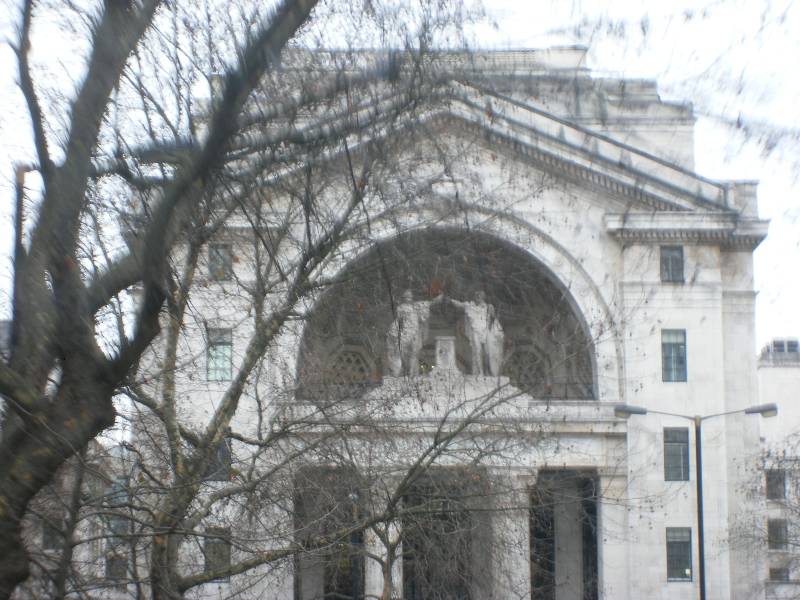
Over the bridge, Linda was prevented from taking her normal river views by the camera battery dying and needing to be replaced.  Still she was back in action as we came round Aldwych, and admired the medallions on the Indian High Commission building, as well as the entrance to Bush House, with its fulsome statement about ‘the Friendship of English Speaking Peoples’.

We were taken aback when the bus terminated here.  Our driver had to come upstairs and pry us out of our seats: she said that she had changed destinations on the signage at Elephant, but we tend to listen rather than look, being occupied  with the passing scene, so had missed the change.  But there,  no harm was done, and we were able to catch another 172 after a ten minute wait outside Clement’s Inn with time to cross the road to check that the little tubby statue looking down Fleet Street behind St Clement Dane’s was indeed Samuel Johnson.  


There was also a notice about a former well, possibly one of the ones mentioned here 

So on we went, past the mouldings of chinese workers at Twinings, and the many pubs and taverns of Fleet Street, to sweep to the south of St Paul’s Cathedral, where the traffic was slowed by ‘works’ as well as tourist buses, and up along New Change, to terminate well beyond St Paul’s Station, This enabled us to catch some attractive gardens in the space left by a blitzed church, and also the statue of Rowland Hill, before disembarking at 10.50


PS If you (improbable I know) are wondering at the delay in blogging this journey, it is of course because of the collapse of Blogger over the end of last week, which also appears to have deleted comments made by readers on several of our routes.


Wednesday, 11 May 2011

The Number 171 Route

Catford Bus Garage (Bellingham) to Holborn

Tuesday December 15th 2009

This is essentially my commute-home bus when I have been office bound all day, but for the sake of our followers I shall try to be a little sparkly and see it with fresh eyes.

PS May 2011: Having now retired I dedicate this bus to Deanne who still uses it for her commute, while she waits for her driving test.

After disembarking from the Number 47, we had only to cross the road for the first stop on Bromley Road and wait about ten minutes for our 171; it was cold but bright with it. All the boroughs we passed through had a range of colourful Christmas decorations, usually strung round the lamp-posts, but of course not lit up at this time of day. The third stop along is outside Laurence House, six floors of offices above a library, so the stops are always busy and today, mid-morning was no exception and very soon the bus was half full upstairs. We passed the two Catford Stations and the David Copperfield pub, and continued round the South Circular leaving to turn towards Brockley, passing rather strangely a woman warmly dressed except for her bare legged flip flops. After Dalmain School with its range of international flags welcoming the community comes the tiger standing astride the Babur, arguably the best restaurant around these parts – be sure to visit its excellent website and you do need to book if you intend going.

Brockley gets its name from the old word for badger: not many of those around these days though no shortage of local foxes, plenty of them thriving in the Brockley Cemetery that we passed. The Brockley Jack pub (named after Jack Law, a local celebrity highwayman (who’d have thought badgers were worth robbing?) who might also, some say, be the origin of the phrase ‘Jack the Lad’) has a theatre attached, which attracts regular reviews and clientele.

Converted in the Fifties from a 1913-built Picture Palace the Rivoli Ballroom is undoubtedly the jewel in Crofton Park’s crown, especially now the Passmore Edwardes library’s days are numbered. Just further on is St. Andrew’s church which holds a nice position on the corner of Wickham Road – it also has a memorial window to the victims of the New Cross fire, the origins of which have never been very satisfactorily explained.

As the bus cuts across to New Cross the wall has a series of active verbs starting with ‘Live, Work, Love’ and ending with ‘Sow and Reap’ attached to the retaining back wall for the houses. New Cross is very much Goldsmiths’ territory which has always been fundamental to the area – many of those who arrive from elsewhere to study often stay put and then become Lewisham residents…More recently Goldsmiths’ has become famous for being where the YBAs (Young British Artists) did their art degrees. New Cross was badly damaged during the war and the then Woolworths was the site of the V2 rocket that caused the most casualties in the later stages of the war, commemorated by a local plaque .

The 171 pushes on along the Queens’ Road where there is significant evidence of new building but also rather strangely a wasteland site complete with burning chimney? All through Peckham there are signs of face-lift such as the Library and Pulse, but also newer blocks of flats, schools and surgeries, some complete with olive trees in huge tubs. There was less traffic than there can be in Peckham (no dedicated lane you see) though the bus was never in a hurry (we put it on a sliding scale between relaxed and dawdling) and as we approached Camberwell sadly there was a major funeral taking place at St. Giles’ Church.

Across Camberwell Green – I have strict instructions not to be rude, but genuinely today was pleased to note the hanging baskets with cheerful winter pansies and the pub now offering a Nollywood experience.

The range of places of worship round here is very extensive and they seem happy to take up residence in shops, industrial units or wherever. The sixties builds along this part of the Camberwell Road are looking tired and even the pub is up for sale – at a reduced price no less. The Walworth Road was pedestrian busy and we rounded Elephant and Castle as before passing the old MI6 building, now having had a face-lift and been converted into swish flats close to Lambeth North station. Passing the Old Vic (sideways on it's less pretty) made us think of the productions we had seen in 2009 – some better than others (we mention no names but we were pleased when they finally cut down those cherry trees in the Orchard...) Up past Waterloo Station and over the bridge, with arguably some of the best views in both directions and a quick swing round the Aldwych, boasting some very fine Christmas decorations, until it disgorged us at Holborn Station, some 100 minutes after starting – could have been quicker but it is a long way and we were not in a hurry.


Monday, 9 May 2011

The Number 170 Route

Monday 9 May 2011

 Linda, Mary and I met at Victoria at 10.00 am on this sunny morning.  In our separate corners of London we had each decided it was too warm for our hoodies, and for much of the day we were proved right.

Terminus Place, Victoria is rather a mess, though we are sure it will be lovely when they have finished with it, but we managed to meet at the head stop, through that little tunnel into Victoria Street, and hopped straight on our single decker, bound for Roehampton.  It is some time since we have been this way, having had a number of weeks in the south and east, so we enjoyed passing the Coach station, and crossing Ebury Bridge Road, where a Hurricane crashed in September 1940 having dealt with a Dornier.  This is of interest to me as I was working in Westminster when archeologists dug up the RAF plane, early this century.

As we passed the grounds of the Royal Hospital, we could see that preparations for the RHS Chelsea Flower Show were already under way:  but don't get all excited, as the tickets have sold out already, with  two weeks to go.  We also passed Crosby Hall, which used to be in Bishopsgate until it was moved here in the early 20th century.  Its coat of arms has some strange sea creatures with stags' heads, and a lengthy Latin motto involving pertinacity and faith.


We had barely crossed Battersea Bridge when we nipped right, along Battersea Church Road, to come to some Octavia housing, called Riverains, and then back to the river and the London Heliport.  I have linked to their price list, as I have no idea what is reasonable and what is not.  Certainly the Freedom pass is not valid on their flights....

The route then brought us back to the main road, and we passed the Candlestore, wondering if we really could smell wax or if it was imagination, and wiggled left along the windy road that brings you out at Clapham Junction.  Clearly the Overground work is going ahead here, and then the ring round London will be complete.  Our route took us along the side of Clapham Junction Station, and then right, so we could really feel what a large station it is.

For the first time since Victoria, a number of people got onto the bus by the little station arcade, and we pressed on, passing the former offices of the London, Brighton and South Coast Railway, as well as the stalled building project whose hoardings still announce that that they won the Housing Project of the Year in 2008.


We reached Wandsworth Common, and headed straight along East Hill and then West Hill to pass Wandsworth's Museum and its striking, if slightly Stalinist, Town Hall.


After crossing the South Circular, we headed left alongside Putney Heath, to the Green Man Pub, aware that we should be returning here in due course to take our next bus.  The main form of housing was really attractive little cottages, no doubt once the homes of aspiring workmen and clerks hoping to breathe country air.  The narrowness of the streets and the parked cars meant that our driver had to be (and was) careful.


Linda and I were especially taken with the font of the internet cafe, the 'e's daringly without cross bars.  Having read Simon Garfield's 'Just my Type' means that we are much more aware of these things than we used to be.


In a different way, we were also pleased with the drinking fountain at the Roehampton crossroads, complete with cherubs, dolphins and a cupola.  It was created in 1882 by John Charles Radford, about whom I can find nothing on the web!

 The housing changed from 19th century cottages to more 20th century stock as we turned to go the length of Danebury Avenue, before terminating at 10.55.  A pleasant trip, with some roads so winding and narrow that we really could not resent the fact that we were not on a double decker.

Friday, 6 May 2011

The Number 169 Route


Wednesday 15 December 2010


Linda was on her way home from Germany, and Mary was busy, so I would have been alone if Andrew had not agreed to come with me.  Taking photos had to be done on my phone, because I had managed to leave the camera behind. 

It was a wet and murky day as we headed towards Barking via the Overground from Gospel Oak, and then walked down from the station to where the 169 would be.  We were pleased to see that it was a double decker, and were off by 10.45.
We admired the advertisements for condom use, reminding us that female flamingoes stick their heads under water when mating. I think those posters were up when we passed through here in the 5.

We set off up the high street and back past the station aiming towards the mosque and then on past many builders’ merchants and timber shops, but also, and more entertainingly, many Asian clothing and textile shops.


Barking turns into Ilford with hardly a break, and the skyline was dominated by the huge new block of flats, Pioneer Point. We went around Ilford on the A123, with a little spin round the cultural area with the Kenneth More Theatre, the Library and a big cinema.  Soon we were out of Ilford, passing on the way a shop belonging to Properties Dubai which seems to have gone bust  We added ‘Hair today’ to our list of hairdressers, resisting the temptation to hop off and add ‘gone tomorrow’ to the sign board.  Along Hainault Road, 1890s terraces were mixed with businesses such as ‘Curry Special’ with a huge flue on its roof, presumably to disperse the spicy smells  .  On a more mundane note, we passed the gritting station, with the lorries braced for the next lot of snow.


We crossed the A12, on our way to Barkingside, noting the huge amount of traffic along it. There were lots of cars parked half on the pavement as we neared Barkingside Station, giving our driver ample opportunity to display his good manners and tolerant nature.  Then we rounded Redbridge Magistrates’ Court, not a very beautiful building, where Nina sits when she is not having fun in Australia.


As we travelled through Barkingside, we had time to note a number of shops:  The Barnado’s shop (‘believe in Children), Mr Simm’s Olde Sweet Shoppe, purveyor of finest confectionery, Cakes and Bakes, offering eggless cream cakes.  There was also Catwalk Pets and Aquatics as well as the St Francis Hospice Shop  raising money for a hospice in Romford.  We also wondered whether Barkingside’s handsome library would survive the cuts.
We passed a large area of allotments, as well as the Clore Tikva School, which is a Jewish Primary School, built in 1999


This was a route serving people coming home with their shopping to the residential areas beyond Fullwell Cross.
And so we finished at The Glade, Clayhall, in the heart of  a network of residential streets, at 11.30, 45 minutes rather than the 24 minutes mentioned on the head stop .  Our driver had been gentle and considerate, waiting for passengers, giving way to oncoming traffic and so on, so clearly his targets are different.  It was a bit of a walk to our next bus, the 128.


The Number 168 Route

South End Green (Hampstead) to Old Kent Road (Tescos)
Monday January 24th 2011

Two top deck rides, top class rides after recent  small infrequent country service (138 & 146) – the contrasts could not be greater.

Mary and I had enjoyed a touristy trip through London  (Route 139) and taken 2 stops on the Overground to emerge at Hampstead Heath Station and indeed South End Green. I get very picky about places that call themselves Green and of course with Hampstead Heath just within sight you have more open space than you can cope with; however the amount of ‘green’ here is very small indeed. We had been to this triangle over a year ago when the Route 24 played up but today we were here for the 168, and sure enough there was one we could board immediately.

In contrast to our previous route which we had had to ourselves this was busy from the off, perhaps because the first stop is actually outside the Royal Free Hospital. As you can tell from the photos, the buildings date from the Seventies when several local hospitals were replaced including New End, the Hampstead General and the old Royal Free from the Grays Inn Road – the original foundation was famed for its treatment of cholera victims and Victoria was the Queen who gave it royal approval. It takes up a corner site on Pond Street and the traffic up and down this quite narrow street (it’s not known as Hampstead Village for nothing) is really too much for Pond Street.

The bus then emerges at the top by St Stephen’s Church, which looks fairly derelict having suffered subsidence from its hilly position and undermining by the hospital building – there have been some attempts at restoration though.

Talking of change of usage, the 168 passes the former Hampstead Town Hall, a fine scaled down civic building, where my parents had their wedding during the Second World War, but which is now a community centre and resource.

As the bus continued down hill past Belsize Park towards Chalk Farm it was pretty nearly full. Haverstock Hill is pretty steep and though a grey day from the top deck we could see as far as the Gherkin. The local pub seems to have re-named itself the Havers.

The buildings down the hill are not very cohesive – a few large old houses, doubtless flat conversions, then blocks from the Thirties Fifties and Sixties sitting oddly alongside each other. Then comes Haverstock School, whose former pupils include the Miliband brothers and the novelist Zoë Heller, who set her excellent novel (later film) ‘Notes on a Scandal’ in a North West London comprehensive. It figures.
By now we were edging into the Chalk Farm /Camden borders with lots of eating places to serve both the Roundhouse and the overspill from Camden Lock. For ice-cream you really cannot beat  Marine Ices with this its only real outlet.

We were a bit puzzled by a hairdresser called ‘Enry ‘Iggins – this is presumably after Professor Higgins (the hero or villain of ‘My Fair Lady’ depending on your point of view) but although ‘Enry ‘Iggins ‘ead features in one of the songs, as recalled in this blog-posting on the possible demise of cockney ,  there is no specific reference to hairdressing that we can trace. On the other hand, we found we could understand why you might call yourself ‘Dappa’ especially when your shop also offers vintage clothing.

Equally puzzling but more unsettling was the street fight that seemed to be going on at a key crossroads hereabouts between two groups of youths. The car in front of us seemed transfixed and was not moving off on ‘green lights’ until it became obvious that one its passengers who had been throwing enough punches to draw blood leapt back into the car and we all moved on? Move the scenario to a side street and later at night and you can see how serious damage might occur.

Just as you think the bus will be going straight to Camden it is of course deflected into the massive 1 way system which takes you round the back of Camden Tube Station (renowned for its interesting and intoxicating aromas) and down Bayham Road round by the 2 Camden Venues Koko and Purple Turtle . They may look OK by night but look rather sad by day.

By now the bus was really full up though it is far from being the only route hereabouts, but after passing Euston Station (actually we had come straight down parallel to the Northern Line) we headed into Bloomsbury and London University territory there losing some of our passengers, possibly late rising students (?).. Interspersed with the head quarters of large organisations such as the BMA are sundry hotels, some of the nicer than others. More blue plaques to keep us on our toes include Sir John Barbirolli (a musical conductor). As you cross over to Kingsway if you look down you can see where the old underground Holborn Station used to be – now sometimes used for filming or more recently the art installation by Conrad Shawcross . There was a large van parked close by the entrance so perhaps someone is planning something new.

We passed Bush House and several Japanese restaurants that seem to have sprouted here and then came round back to King’s College, London, Somerset House and back over Waterloo Bridge.

The journey from here is only too familiar, so forgive us if we wrap up our account fairly swiftly – Waterloo station and the mighty Elephant & Castle complete the shadowing of the Northern Line and then it was round the Bricklayers’ Arms. . We decided that the low status of the Old Kent Road on the Monopoly map had never done it any favours and the piecemeal rebuilding after bombing and other destruction makes it disjointed. The Heygate has been empty for some time now – it is seen so often in police dramas on TV that I hope Southwark Council is making some money out of it, but no signs of a rebuild yet?

Very soon it's our final stop outside the mega Tescos – an hour from NW London and familiar stretches apart really quite an interesting journey from classic Hampstead through trendy Camden, the heart of Bloomsbury, cross the river and for Mary and me – nearly home.


Wednesday, 4 May 2011

The Number 167 Route

Monday 13 July 2009

This was our third bus of the 5 bus day, but we were undaunted. Although the 167 was signalled as three times an hour, we waited less long than for the 73. Having noted the monochrome nature of the population of attractive, flowery Debden, we were delighted to have a non-white bus driver, who retraced the 20 route with a brief detour down Pyrles lane to serve the many houses in the area. We therefore had another chance to admire the posh independent shops of Loughton, as well as doing the station-and-Sainsburys loop before turning away up Alderton Hill. The Blue Plaque at Roding Valley High School, a performing Arts College, proved to be a Loughton Council clone, and commemorated Winifred Darch, author of school stories including ‘The Fifth Form Rivals’ and ‘Margaret Plays the Game’. She was a teacher and house mistress at the school in the early part of the twentieth century.

Back down through Buckhurst Hill, we were entertained by a young man and his girlfriend. When she squeaked as a wasp bumped along the window beside her, we offered him a bus map to kill it with. But he said it wasn’t doing anyone any harm, and was sunbathing. He then spent a while trying to persuade it into his hand to steer it towards a window, without success. When another young woman screamed and changed seats to avoid it, Jo was delighted at her own stoic calm, evidence that actually being stung a couple of years ago had reduced the phobia to mild dislike.

Buckhurst Hill has a Cricket and Lacrosse Club, with separate websites for each sport.  Personally, having played lacrosse in a reluctant fashion at school, I am impressed that there is a League.
We were soon amid the somewhat pretentious pseudo-Tudor-but-with-classical-columns of Chigwell and over the M11, seeing the River Roding from time to time as we approached Gants Hill Station, repeating parts of our 296 trip, one of today's five, about which you will read in due course. The repeating routes of today meant we had time to notice several witty hairdressers: Heads Up, Kutting Krew, Hair Hunters, Etti-Cutt, The Cutting Edge. Could this become our substitute for Blue Plaques? (Clever montage courtesy of the 63 - former - regular)
We passed Valentines Park and Mansion and Valentines School. Clearly we shall have to come back another day to explore its listed 18th century garden, saved from housing redevelopment in the 19th century by the Council, which now owns it.
Into Ilford, which we feel we know quite well, and past the roadworks, which will have been completed by the time you read this, we off the bus after just over 60 minutes from Debden and were ready to embark on more Essex buses.

The Number 166 Route

Tuesday 3 May 2011

 Our first journey of a long day should have begun well:  West Croydon is easy, thanks to the Overground, and Linda joined me on the train, Mary being busy with other things today. (You would not know how easy it is, however, if you were relying on the TfL Journey Planner, which persists in ignoring the latest member of the family.  When asked how to get from Camden Road to West Croydon, it offered me a journey via Clapham Junction and South West Trains, rather than a simple platform change at Highbury and Islington.  But I digress)

So we arrived at West Croydon's busy bus station on the dot of 10.00, to be dismayed to learn that only one in three 166 buses go to Epsom General Hospital, the official end of the route, and we had more than 40 minutes to wait. (The rest stop in Banstead, by the way) But we were not downhearted, and the proximity of Marks and Spencers enabled us to fill the time and Linda to buy a dress.

So eventually, at 10.50, we were onto our single decker, and heading along Croydon's dual carriageway, with attractive if subtle baskets of white and yellow, to reach 'The Croydon Underpass' so named, we supposed, because it dates from a time when such things were new.  We noted again how many trams traverse the centre of Croydon, before heading out to their various destinations;  it is hard to believe there are only three tram routes altogether

 We turned left at the building which was once Grant's Department Store, with its offers of hats, trimmings, linens and so on it the stonework, and came to the former 'Whitgift Parade', also announcing itself on its facade.


As we travelled south, we saw several pubs, including the Crown and Pepper, which is now, apparently, the Aja Lounge, and the Tree House, which is a large pseudo Tudor building with a restaurant called 'Upstairs'.


 We also noted 'The Magical Haircut' coiffeurs, and the Southleigh Community, which is an organisation that provides accommodation for people with mental health problems.

We were pleased with our steady progress until we reached the Swan and Sugar Loaf where everything ground to a halt.  There were roadworks,  with Nightingale Road closed and traffic lights to control the traffic from several directions, so  we had time to notice that at Hayling Park they were advertising a cricket match between Surrey and Essex.

We also had time to glance into South Croydon's bus garage, but this was because there was a relaxed and jovial change of drivers. It was becoming clear that the chance of us hitting the 60 minutes official journey time was pretty well zero.

 We came to one of those reminders of a changing world, when we passed the Royal Oak Centre, with gym and cafes and such, but the Royal Oak Pub, for which it was all presumably named, boarded up and gone forever.

At the Rotary Field we noted the funfair, packing up to move on after the many Bank Holidays of the past weeks.

Today's interesting Religious opportunity was the Beth Hillel Messianic Synagogue, of American origin though apparently unrelated to the similar, also American, Jews for Jesus.


As we travelled through Purley, where many people got on and off at the large Tesco's, we came to more roadworks, but by now we were hardened to delays.   We were in a residential area, with most of the front gardens bricked over, and a number of the substantial houses given over to medical and quasi medical establishments.

Along Chipstead Valley Road, the winding, lanelike nature of the road made it quite difficult to photograph anything, though it helped to explain why this busy route was served by a single decker.  Earlier, as we sauntered down the Brighton Road, we had felt  double decker would have been fine.  But now, as we travelled up and down the hills into Woodmansterne, the good sense of the bus company became clear.  There was a fine piece of wood sculpture on the green, of which I have found a great picture but no explanation!

The Old Walcountians, whose sports ground we passed, prove to be the alumni of Wallington County Grammar School.  Soon we were back among large properties, including a care home from the Sunrise company. High hedges protected the homes from the busy road, and there was a feeling of countryside, with Huntersfield Farm and Livery Stables, and several nurseries.

Eventually, we reached the Borough of Epsom and Ewell, and passed the former Cottage Hospital and the University for the Creative Arts, which includes the Royal College of Needlework, and so has a link with the recent royal wedding dress.

Our route to the hospital took us through Epsom town centre, and past the small Playhouse, before heading out of town along the Dorking Road to arrive at Epsom General Hospital at 12.10.