Sunday, 22 April 2012

The Number 320 Route


Biggin Hill Valley to Catford Bridge Station
Wednesday March 28th 2012
 
I have to confess to having a soft spot for this route as, after its being stretched to include Catford as the end point (a late 2010 decision), it served me very usefully to get down to Bromley and points beyond, and relieved the crush on the 208s. Clearly, however, this decision was not popular with everyone.

The driver of our previous route – the even more remote serving 464 – let us off at what he said was the first stop for the 320; however, when this venerable double-decker arrived with about five passengers already on it we knew we had somehow missed the absolute beginning. The first haul is to climb Stock Hill to serve Biggin Hill village – more folk on. Though at the very edge of Bromley’s domain they seemed well provided with a Leisure Centre and swimming pool, though the council may need to trim the overhead trees a bit more soon – if they bang in early spring what will they be like by high summer? The Black Horse pub faces the War memorial so all quite compact.


This route allows for a better view of. Biggin Hill Airport as it follows the perimeter fence: we spotted a helicopter taking off and other small aircraft. There are also the remains of the former RAF Base, which has a very illustrious history having served in both World Wars. It also hosts an annual air show which commemorates the history and commercial potential of the area.


No big excitements today so the 320, now filling up, steamed straight ahead to the aptly named Leaves Green, which seems to be part of Keston Common. There was an excellent view over to the left, presumably towards Hayes and Bromley and SE London. Young's pubs always present themselves well and while we had seen better drawn doves (like Picasso aged 6 or so could draw) it seems to be a regular, not over prettified country pub. Apart from the statutory one- way wriggle in Bromley this was essentially a straight SE to more northerly SE diagonal so did not stretch the driver’s navigational skills overly.


At the end of Oakley Road we spotted at least four people fishing. As this review indicates it is pretty close to a main road and indeed we were about to join the A21, here known as Bromley Common – the traffic can be slow here but today was fine and stragglers from the hospital and even more potential students boarded for the short ride remaining to Bromley College. This is clearly a well-used bus, and for those at the more distant Biggin Hill end presumably the only way of accessing a train line into London.

Not far from the fishing pond we saw a little lodge house, which seems to give access to a banqueting suite
 ( wedding venue ) further back on what remains of Bromley Common. 

Nearly opposite – and I expect they hope to attract some newly weds – is the Trinity Village development , where large numbers of new homes have been and continue to be built.  One website says this was a former Blue Circle Cement site though on the map it looks as though it may have been more of a green than brown field space. 536 new homes makes for quite dense housing and will surely impact on the road also?

The bus took on a disabled young person plus parent and a several more students from the college. Bromley had the usual landmarks on offer: both South and North stations and a glimpse down the pedestrianised High Street before taking the route round the back of the Glades shopping centre, complete with the central reservation beds fully planted up and glowing with colour. 

As it happens Bromley describes itself as the ‘greener borough’ and today fairly made this true; it is also London’s largest borough in terms of area covered and probably one of the more affluent. On reflection, and I do not pretend we spotted this en route, we were sort of following the River Ravensbourne, which starts down in Keston and is still going strong by the time we entered Lewisham on the last leg of our trip. Here’s some more information if you like river rambling…

The bus was busy again through Bromley, so filled with a new load of passengers we progressed up the London Road and Bromley Hill to Downham and Catford; the latter was visible on the horizon and by this time already under a slight haze. Catford in Vaseline lens soft focus is quite a positive experience, so we were quite mellow by the time we stopped alongside Catford Bridge station, barely an hour after we had left rural Biggin Hill over 8 miles away.

Completing this route also marked the end of our passing through Catford as we have already ridden the 336 from here on a trip we prepared earlier…so here is Catford’s most spectacular magnolia.


Friday, 20 April 2012

The Number 319 Route


Streatham Hill (Telford Avenue) to Sloane Square
Monday April 2nd 2012


A Southern region train and short walk had brought us from the end of our last trip on the 315 to wait at a lively bus stop known as Telford Avenue but which is really the very busy Brixton bus depot. We know how busy it is as thanks to a photo shoot for an article by the Great Wen last year we had spent some time in there marvelling at the parking skills of bus drivers. Today we had plenty of time to watch them, as they shuffled in and out of the garage. We decided that the 59s and 159s bully everyone else as they arrive every 5 minutes or so. Our 319 appeared on the countdown LED only to disappear just when ‘Due’  ‘Captured by aliens?’ said Jo.

When the next 319 emerged from the garage it turned right and headed north to Brixton – this is a very confusing route whose eventual destination is well north of the river but which resolutely sets off south. The next 319 sidled out of the garage, sat behind a 159 while three of us dodged to board; however, the driver then switched off his engine and disappeared – no room at the inn?

Finally, after about 20 minutes all told, the third 319 seemed prepared to take on passengers. The next glitch was Streatham High Road heading south, which was more or less at a standstill, due apparently to some road works further down the hill. This gave us all too much time to note the dereliction now very obvious in the buildings that once housed Caesars (gone but not forgotten)  and the Bowling Alley (there’s a new one due down by the swimming pool). At least the cinema (which used to have a car park that smelt strongly of pee) has been turned into housing going by the name of the ‘Picture House’. 


Once past the English Martyrs and St Leonard’s churches, our driver in his rather squeaky elderly double-decker, with competition from a variety of white vans, had to negotiate a couple of tight corners to start heading west, starting with crossing the end of Tooting Bec Common , a part of the route shared with the 249. By now we had been joined by another 319 though interestingly both of them were quite full. Jo joined me on my seat so some children could have the other front seat, on what looked like a holiday outing. 

At the Northern Line station the 319 continues straight ahead along Trinity Road lined by fine houses – once multi-occupied and neglected but now evidently seen as more desirable single occupancy  properties. This becomes ever more evident as we approached Bellevue Road and Wandsworth Common station, an enclave where several boutiques and delis have sprung up including ‘Tickled Pink’ and ‘Bellevue Rendezvous’ reminding us of Sylvain Chomet’s wonderful animated film  'Belleville Rendez-Vous' (or how to train your son to win the Tour de France).  Most attempts to glean further information on these shops landed me in such unutterably smug websites that I refuse to link to them. 


It was to continue thus as the 319, unique route at this point, does a wriggle round Broomwood Road to then head up Northcote Road complete with more eye catching names: a branch of ‘Trotters’ (expensive children’s clothing), the ‘Underdog’ and flowers from ‘Ultraviolet’. You get the picture.

More to the point is that this route more or less follows what the course of the ‘lost river’ Falcon. According to Paul Talling’s research the river rises from two near by but different sources, one very close to where we boarded this route; it then follows through Tooting Common where it is joined by another stream formerly the Hydeburn (we lived in Hydethorpe Road once) before flowing through the Northcote Road ‘valley’ which as you can see from this photo does indeed dip in a most satisfactory way. 

The Falcon pub still stands at the major crossroads at Clapham Junction today, partially obscured by remaining road works. Compared to the rest of the trip this sometime bottleneck went fairly smoothly and soon we were heading down to the River Thames (as the late Falcon would have done) and to Battersea Park Road. This part of Wandsworth Borough remains very mixed – there are extensive local authority housing estates built in the Sixties to compensate for war-time destruction, though given Wandsworth’s often Tory complexion some have been sold off. In between are what would have been workmen’s cottages and closer to the river those grand mansions overlooking the park. The mixture of shops – cheap takeaways and vintage frocks – reflects the mixed demographics. I suppose you could say a major influx into this area has happened since the Royal College of Art opened its Dyson building here – there is quite a jolly if frenetic time-lapse film about the building going up, which contrasts with the apparent peace of the site now, seemingly complete


Today we could enjoy at leisure the high tide as we crossed the river very slowly allowing full enjoyment of the view both ways – the additional bonus for Battersea Bridge is looking down on the houseboats and some visiting Dutch barges. 


This was to be our last trip along this end of the Kings Road and again progress was slow mainly due to the sunshine at lunchtime bringing both tourists and locals out to the shops. The wealth that is Chelsea needs no introduction and we enjoyed looking into the key holders only private squares that the view from a double-decker permits. This end of Chelsea has its share of blue plaques – one for the totally forgotten ballet dancer and then the more memorable film director (Sir Carol Reed).

The other remarkable though not memorable aspect of this route was that it was a 3 Cath Kidston store route: we passed the first in Northcote Road and the other two along the King’s Road.  Fittingly the bus finishes in front of Peter Jones having taken more than an hour to make its way here. It being a while since we have been through inner London we had forgotten how slow it can be!


Thursday, 12 April 2012

The Number 318 Route

Wednesday 11 April 2012


And lastly, I said to myself on this fourth bus of the day.  I said it to myself because both Linda and Mary were otherwise engaged, though I was thinking of them as I travelled.  The 491 had brought me to the North Middlesex Hospital and, while I’m sure it is a lovely place to spend time, I was glad to step straight onto my 318 at 13.25, headed for Stamford Hill.

It was one of those small buses with only one set of doors, and I wondered how the passenger in her electric wheel chair had managed to get on.  I was to discover, when she got off, that her extreme competence at the controls, and the shifting of a couple of buggies made it easy.

We pulled out of the hospital and straight into a Hail and Ride section, along Bull Lane, with a business park on one side and playing fields on the other.  A right turn brought us into an area of housing, and to Tottenham cemetery, a huge expanse, not yet full.  As we turned left onto White Hart Lane, I was not surprised when a pair of tourists, guide book in hand, asked where the football ground was, and were told to cross the road and go the other way.

We came past Cavell Road and Jellicoe Road.  It was quite a change to have some First World War names as my morning up to now had been full of Boer War references, Ladysmith, Mafeking and so on.  At this point, the rain, which had been threatening on and off all morning,  finally got going and our driver stopped, perhaps a little suddenly, to offer a ride to a man with a baby in a buggy.  The housing around here appeared to be former public housing, much of it maintained to a high standard.

We came down to Bruce Castle Park and then to Enfield and Haringey Magistrates Court, which appears to have escaped the cull, before turning left to travel through residential areas before getting back to Tottenham High Street.  At this point the raindrops were substantial enough to be called sleet, if not snow, and there were hailstones as well.  Bruce Grove Station seemed, by the route we had taken, a long way from Bruce Castle Park, though of course it is not. 

The most interesting shop we passed was the Confidence Money Centre, which incorporates the Morning Glory Boutique, though I was also taken by a Sedation Clinic, which proved, perhaps disappointingly, to be about dentistry, rather than general ‘life’s-too-much’. 

We had a driver change, which gave me the chance to admire the Tottenham Borough signs, before we passed the Town Hall and came down to Seven Sisters Station.  I can’t remember if we have previously reminded our readers that the seven sisters were trees, not nuns or a large family, so I shall do so now. 

Our bus got quite busy here as there is also a large supermarket.  We entered another Hail and Ride section as we travelled past South Tottenham Overground Station and took a further detour into a residential area, heading quite steeply downhill towards, though not reaching, the reservoirs.  Several further turns brought us back to the main road (now Stamford Hill) where the bus terminated, at 14.05.

I was surprised at how speedy the journey had been, as these are serious shopping streets, but then people do manage to get on and off quite efficiently, even when it means abandoning the nice warm bus to face the rain.

The Number 317 Route


Wednesday 11 April  2012

Although I was on my own today, both Linda and Mary being busy with other matters, I had resolved to do a serious tour around and about Waltham Cross, and the first of my four buses departed from Little Park Gardens, a brief walk from Enfield Chase Station.  Despite its flowery name this is, in fact, a bus station, albeit one with locked toilets.

I was pleased that the weather was doing the 'bright' bit of 'bright with heavy showers' as I climbed to the upstairs of what was to be the only double decker of the day.  It was just after 10.30 as we headed along Church Street.  I noticed that no-one was shopping in the travel agents, of which there were several. I assume a growing number of people book on line.

It was the wrong day for Enfield's market, as I had time to observe, because our driver was the kind I prefer, who stops on yellow rather than accelerating!  I could also note the plethora of banks, huge Barclays, Nat West and Lloyds as well as the smaller Northern Rock Branch.  I thought the Noodle Bar, named Kung Fusion, more entertaining


 We were heading straight towards the east, and for a while the New River flowed alongside us.  It had less duckweed, but more ducks, than last time we passed it, though regrettably no ducklings yet.

The All Talents Music School has a charming video on its website, including a mother saying that it keeps her son busy in 'a positive way'.  I also noticed that the houses around here were built near the start of the previous century, names like Mafeking and Kimberley being the clue.

At this stage we crossed the A10 (or Great Cambridge Road, as it prefers to be called) past the huge cinema, where families were going in to enjoy the holiday shows.  We looped round the business park there, though no-one wanted to get on or off till we reached Sainsbury's, and I photographed some of the many offices to let to prove to Linda that I care about her views even when she is away on holiday.

Then we were back onto the A10, heading north.  This was as well, because the southbound carriageway was completely blocked off by police in large numbers, causing major tailbacks.  The cause proves to have been an incident involving a motorcyclist, which had happened at about 08.30 in the morning, so the traffic had been disrupted for some hours by the time we got there.  Indeed, the traffic was motionless pretty well as far as Enfield Crematorium which was, by the way, lookoing attractive and spring-like in the sunshine.

We continued straight north towards Turkey Street Station, before finally turning right at Lea Valley High School.  This took us into the borough of Broxbourne, and we crossed the M25 to reach Waltham Cross bus station just after 11.05.

I think I was very lucky to be going north rather than south, or I might still be waiting for the traffic to flow.


Tuesday, 3 April 2012

The Number 316 Route


15 June 2009

This was a part of a three bus journey very near the beginning of our project, which had involved the 16,  close relative of the 316, bringing us to Cricklewood from Victoria


After our little expedition to Lidl (and renewed thanks to the helpful staff there) we climbed onto the 316, our first single decker bus for some time.  We retraced the 16 route as far as Cambridge Avenue and Kilburn Park Station, but going East was much slower than going West.  The bus is well-used, mostly for shorter journeys: a lot of shopping trips, clearly. The engine made loud blowing noises at almost every stop, which annoyed us more than it seemed to bother the driver. To pass Watling Gardens was a little strange:  Roman Watling Street linked London to Dover;  but the name is used on parts of the A5 as well.  A pub calling itself ‘The Good Ship’ announced that it was ‘transmogrified’ and we noted a surprising number of B and B establishments.  Linda’s professional eye suspected that they were more in local authority use than for visiting tourists.

 We spent some time tracing the Bakerloo Line, and some time on the 6 route, and passed the Roger Gracie Academy of Brazilian Jujitsu (no, nor did we…)  Then we were back on familiar territory as we went down Ladbroke Grove and over the canal, where we just glimpsed some passing boats.  Then we were into the car park for ‘Sylvia’s Sainsbury’s’.  From the bus, we could not see the memorial garden to the dead of the Paddington Railway disaster of 1999 though we know it’s there somewhere. We looped round St Charles’ Hospital, where Sylvia spent a few weeks in the 1990s.  I’m sure it’s cleaner now than it was then:  it is impossible to imagine it being dirtier…


The attractive houses in Barlby Gardens made us aware of the powerful scent of flowering privet, and reminded us of Michael Frayn’s novel Spies.  The bus wiggled round Cambridge Gardens and under the Westway. St Ann’s Villas has a Blue Plaque for Albert Chevalier, the Music Hall comedian, who died in 1923.  We had noted that there were fewer blue plaques than on some of our trips.

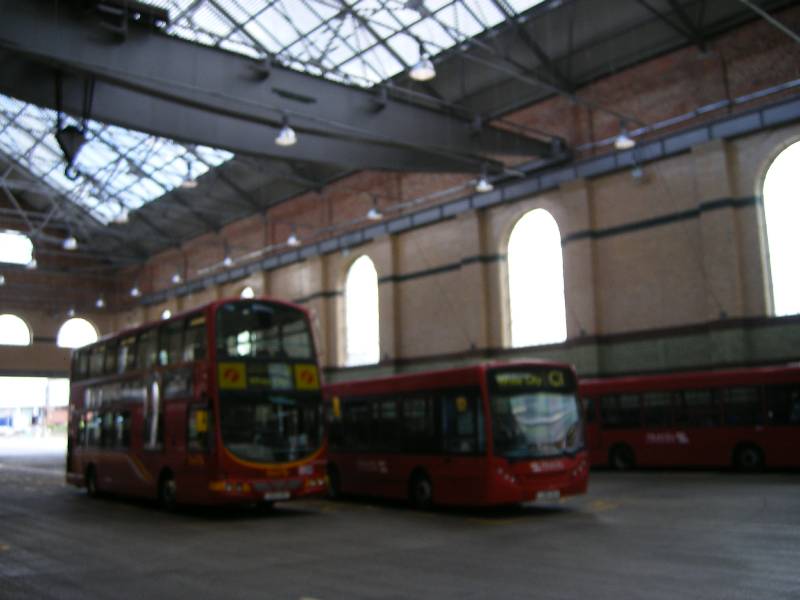
We were expecting White City Bus Garage to be a bit bleak, but it was magnificent, with an amazing bus cathedral where some of the buses were resting:  occupying a huge area at the back of Westfields shopping centre, it had pleasantly planted tubs where Linda and I enjoyed our sandwiches before getting onto the 31.


(how strange it seems now, almost three years on, that there was once a time when we did not know about White City Bus Station!)


The Number 315 Route


Monday 2 April 2012

 Linda and I met at Balham Station, an easy journey for both of us from our different directions.  The area seems to be much smarter that when Linda started her married life there.  As we waited for the 10.20 bus (they are three times an hour) we considered the bronze reliefs set into the high wall behind the bus stop.  They are by Julia Barton and depict impressions of Balham.  They were made in 1991 We thought one of them was probably Hildreth Road Market, and one seemed to be of a school or at least some children.  We also had time to visit the fine bookshop across the road.

Anyway, our small (only one set of doors) single decker bus arrived and we headed off to loop round a bit of the High Street, with the entrance to Hildreth Street Market and the large Sainsbury’s.  There’s a Waitrose opposite, so you can see what we mean about the changing demographic of the area.  We saw that we were heading along a cycling superhighway (8, I think) with the customary number of parked cars and vans rendering it ineffective.

Houses, as we headed towards Tooting, were large and well built:  we thought a number of them were probably whole homes rather than being divided into flats, though this was only an impression gained from the neat front gardens and uniformity of windows.
The Waldorf School of South West London appears to be a branch of the Steiner Schools:  we only saw the charity shop by which it presumably raises funds.

There were lots of luminous forsythias everywhere, and a silver birch completely covered in catkins, as we came towards Tooting Common, and round two sides of it to join the Tooting Bec Road towards St Leonard’s Church in Streatham. (His home town in the Limousin is, by the way, the home town of the great cyclist Raymond Poulidor;  I thought you would like to know)
The equally large Catholic Church opposite is dedicated to the English Martyrs, who were of course executed for treason (refusing to reject the foreign authority of the Pope) rather than being burned as the Protestant Martyrs were.


Shoppers were getting on and off the bus as we came past some really substantial homes, including one with an almost Muscovite cupola.  We also passed a ‘decontamination’ van parked alongside one of the houses.  Our imaginations boggled:  rats?  Interstellar rays? Actually, I suppose asbestos is the most likely problem in these mid 20th century houses.


There were some steep hills, made even more difficult by parked cars, but our driver coped smoothly.

And so we came into West Norwood, passing the back of the station, and the large church dedicated to St Luke, one of the four evangelist churches built as the suburbs grew, and as a thanksgiving for the victory at Waterloo.  Its foundation stone was laid by the Archbishop of Canterbury in 1823

A ghost sign on the wall for Brymay matches was a reminder of how much people used to depend on naked flames. We also admired the ‘Floral Hall’ florists.  We thought we should end at the Norwood bus garage,  but in fact went on for a couple more stops, the driver having said he terminated later on:  he was amused and somewhat baffled by the project:  did we realize that there were over 700 routes in London?  And weren’t there more enjoyable ways to spend our time?  We did not grudge him his opinion,  as we had been impressed by the way he steered his bus through narrow, parked up streets, and round steep corners, and also by his good nature in the ‘hail and ride’ sections.

We had had a sunny half hour around this residential area of south London.