Tuesday, 15 March 2011

The Number 153 Route


Monday June 29th 2009

This was a glorious summer’s day with temperatures in the high twenties: definitely the hottest day of the year so far.  

This route was in fact the return leg of a very enjoyable trip on the Number 19 but certainly offered some contrast to that route. The bus is a single decker, and for the fist time we had a female driver, a relative newcomer still receiving support or advice from a more senior colleague but doing very well along what proved to be quite a testing route starting with cutting through some narrow back streets and across major roads and ending with pedestrians jaywalking through the City…

Finsbury Park Bus garage is dominated by the official Arsenal shop, not yet displaying the new kit. In keeping with being so close to a major sporting venue, the just out-of-sight Emirates, the local area was lively with a range of fast food outlets. 

As we sped off towards the Caledonian Road, then branching off it, we passed both a smart GP Practice ‘The village’ and the Medical Foundation (for the Victims of Torture) originally set up by Helen Bamber, who now works as a consultant therapist for the Centre – the London branch of which is now housed in this rather splendid new building in Isledon Road.  Further on we came to the Sobell Leisure Centre, now part of a chain, but still offering indoor sporting activities for the local community. Michael Sobell himself was a business man philanthropist rather on the traditional Victorian model, though he was a twentieth century man. Even this far from Emirates we noticed the parking costs reflect different rates dependent on whether there is a home match or not.

Throughout this trip, the majority of which was in the London Borough of Islington, we were impressed by the amount and often the quality of the social housing often very adjacent to some of the most expensive and desirable property in London, and sometimes the two coincided.  We continued along Tollington Road and across the Holloway Road where Morrisons and Waitrose do head-to-head consumer battle. Along here are several buildings for the London Metropolitan University North Campus, not to be confused with the London City University which came later in the trip!

We bore right along Liverpool Road and passed another little oasis in the shape of Paradise Park, and then skirted the back of Pentonville Prison arriving somehow at the side of the Islington Sainsbury’s – a popular disembarking point for many of the passengers.  On the corner of a building we noted a sign commemorating three churchwardens who, our historian reminded us, were responsible for the drains, and other things such as Poor Law relief within their parish back in the day and this corner of Upper Street seemingly denoted the bounds of their responsibilities.


 We were back on St John Street EC1, this time going its entire length past the Queen Boadicea Pub, complete with ship’s prow, and the City University. The bus skirted two sides of Charterhouse Square, so we just glimpsed some of the Bart’s hospital buildings including one where Mary had been a resident – she also remembered a rather traumatic trip to a local hairdresser as she nipped out from her medical studies and like her local butcher glimpsed earlier on the 19 route there still seemed to be a hairdresser doing business on the same spot.


Soon thereafter we found ourselves going under the Barbican complex and round the side through some very narrow streets – on one side The Brewery was having loads delivered while opposite an unidentified skyscraper just towered into the sky.  Silk Street, Moorgate and all the adjacent streets were all incredibly busy as this was lunch-time, and all the workers were out there enjoying the sunshine and their break.

Mary and Linda were a little concerned, eavesdropping a conversation behind us, where a young woman was giving way too much information about her personal history to a stranger fellow traveller – fortunately he seemed to take the information in his stride and did not take advantage of the situation.
 
We joined the lunch people and ate our sandwiches perched on the Kindertransport memorial (see the start of the Number 11) at Liverpool Street, complete with accompanying pianist, having experienced a very satisfying trip which took us through some areas Linda, more than her companions, had never seen, and all in just under an hour. 

The Number 152 Route

Pollards Hill to New Malden

Tuesday January 4th 2011


This route offered one of our most effortless transitions between routes, namely getting  off one bus and onto the next from the same stop in Pollards Hill. Our bus was a single-decker, though we did meet a double-decker 152 en route – the bus companies must struggle between meeting passenger demand which for this route seemed considerable and the need to have a smaller more manoeuvrable vehicle to send round more intricate routes, which the 152 proved to be.  

For starters we had a more detailed tour of the newer parts of Pollards Hill, the streets named for English counties (Yorkshire/Berkshire/Hertford) and a few for castles (Conway and Carisbrooke) so you can tell the density of housing round here is considerable and with few corner shops around the passengers needed to go further afield to shop. For a brief while we retraced our steps of the Routes 60 & 118, past the Harris Academy for Merton, where they offer skills classes for adults also, and the community facilities of New Horizons and Commonside, but the bus soon branched off, very much the only route round Grove Road and Locks Lane passing a very new station called Mitcham Eastfields. There was considerable debate amongst the Ladies who bus as to whether this was
a) really a tram stop or
b) a shabby old station someone had renovated

but it proves to be a TOTALLY new station (plans were suggested back in the Thirties) to serve an area poor in trains. What’s more we actually stopped at the level crossing to watch a train pass!


Between here and getting to Mitcham we noted some extensive if densely packed allotments (Merton seems well provided with these) and St. Mark’s Academy School. Rather to my surprise (having lost all sense of direction doing some circling in Pollards Hill) we joined major routes at the Mitcham Town end of Figges Marsh.

We are very familiar with Mitcham and today passed only one of its Greens but noted Raleigh Way. Jo had discovered, whilst researching the 127, that Sir Walter of that name and cloak had owned land round here so now he is forever to be commemorated in the 1-way system. Having looped a little north to be heading west the 152 was again forging into new territory, what might be termed the borderlands of Mitcham to Merton. As a local friend puts it Mitcham is the bit that Merton forgot, when it came to handing out urban renewal.

Some of this route is a little unlovely with gas works, though a local Primary school cheered us with its colourful fence and railings. Then as you approach the major road junction with the A236 (we thought it must be much more important than that) you come face to face with a huge and hideous empty, derelict office block of some size. There have been some injections of retail outlets in the area with the rather new looking Tandem Centre but the pedestrian access to the centre looked poor and as yet the buses do not go in directly.

Anyway we were soon on a more familiar looking High Street, Colliers Wood which blends into Merton High street, and we could tell there had been shops for a while as there was an excellent 'ghost sign', photographed especially for our sometime technical support aka  63 regular. (The above blog – which has recently,  like ours a few weeks ago,  been featured in the Guardian’s blogroll – looks at facets of hidden old London with a more detailed eye than is possible to those of us passing by on a bus.)


As mentioned on the 131, this area has a rich industrial heritage, bits of which are still visible along the River Wandle. Doubtless drawn by better employment prospects here, there was once (still is?) a sizeable Irish population as the names of the pubs (The Kilkenny) local solicitors and shop names still indicate. The other folk commemorated round here are Nelson and his mistress Emma Hamilton: ‘her’ pub looked quite derelict but ‘his’ hospital is still going. It is an old building though and the services are purely out-patient ones. Nelson had bought Merton Place for Emma, but after his death she could not afford the payment for upkeep and eventually died a pauper; she is also famous for having posed more than once for the portraitist Sir George Romney. Shame about the demise of the pub as the choice of portraits for the pub sign would have been extensive!
Things were just getting posher with such shops as ' Grate Expectations ', which seemed to dominate the station and the very delicious-looking  La Bottega del Pane, still with its tasteful Christmas decorations.


We passed for the second time today a station that we had never heard of: Wimbledon Chase – and crossed another railway line – this time without benefit of level crossing gates! (This would appear to be the Epsom to town line so not to be sneezed at.) Then came a diversion where we appeared to go backwards but a more seasoned passenger explained a road was blocked off and the route was making sure it accessed Raynes Park Station before rejoining its former route to New Malden. Mary had spotted the Edward Rayne pub so we could research  after whom the area was named.

The bus map shows this route as crossing the A3 but what actually happens is that there is a sizeable slip road for local traffic, much of it built up with major outlets such as B&Q and a giant Tescos which goes alongside and beneath the very substantial A3 which here is usually known as the Kingston by-pass. Jo reminded me we had once walked bits of the A3 to get from one bus route to another via Richmond Park. This stretch was decidedly less scenic and less pedestrian friendly, so we were not surprised that it had been developed by businesses rather than for residential buildings. We spotted a Korean wholesale outlet which proved to be the key for New Malden’s current identity.


The bus terminated after 55 minutes offering mainly a residential experience uniquely punctuated by 2 railway crossings and 2 little known rail stations so quite a voyage (does that have to be by boat?) of discovery in less than an hour. From the Fountain, which is a real one not a pub, and is where the bus terminates, we walked the length of the lively and pleasant New Malden High Street and soon discovered why there was a nearby Korean wholesale outlet. Clearly the South Korean community South Korean community has taken up residence here big-time, and by now rather hungry we were being tantalized by the sights and smells of Korean food.


Monday, 14 March 2011

The Number 151 Route

Monday 14 March 2011


We - that's Mary, Linda and I - had never been to Wallington (Shotfield) before, but this was not a problem, as our previous bus  terminated a mere 10 metres up the road.  We were pleased to see that it was a double decker,  though later on we were to see single decker 151s in the other direction.  Our driver was having a brief break, so we had time to admire the skeleton of the new Medical Centre, and wonder if it was what local GPs would want when they get their hands on all the money.


The bus set off at 11.10, passing the attractive little Town Hall, and turning into the main shopping street of Wallington, where we were joined by a large number of passengers, most of whom stayed downstairs with their shopping.  We made a brief loop to get us to the forecourt of Wallington Station, and then headed on westward, passing the attractive white painted buildings of the Duke's Head Hotel.  Before moving on, let me state what a pleasure it is to find a pub website that actually explains the history of the place.

We headed out of Wallington, passing the rather stark War Memorial, as well as hosts of golden daffodils (to coin a phrase) though they were not particularly 'fluttering and dancing', being mostly tete-a-tetes.  We thought they were a good idea for municipal planting, being less likely to suffer wind damage, and also being less desirable as Mothering Sunday gifts.

We passed signs to the Wandle Trail, and then went over the River Wandle, which is looked after by the Wandle Trust. After going past Hackbridge Station, we went over another loop of the river.

Alongside us as we headed into Carshalton were handsome and well tended allotments (Mary being a connoisseur of such things) as well as some houses with solar panels.   We were enjoying such a beautiful, sunny day after the damp and unpleasant weekend that the panels seemed particularly appropriate.

Ahead of us now rose the vast white shape of St Helier Hospital.  Mary told us that that was where she did her Obs and Gyny rotation when she was a student, delivering her first twenty babies both in the hospital and with a sort of 'flying squad' that went out to people's homes.  St Helier was (of course) a sixth century man from (modern) Belgium who 'caused consternation with his youthful miracles' before becoming a monk and settling in the Channel Islands  The hospital itself was named for Lady St Helier, a London Alderman, and was painted green during the Second World War to avoid catching the eye of passing Luftwaffe pilots.  Opposite were swathes of wonderful daffodils, guaranteed to catch anyone's eye.  St Helier Hospital has just been given £219,000,000 for a refurbishment project, which must help the local people, who elected a Lib Dem, to understand the term 'quid pro quo'.
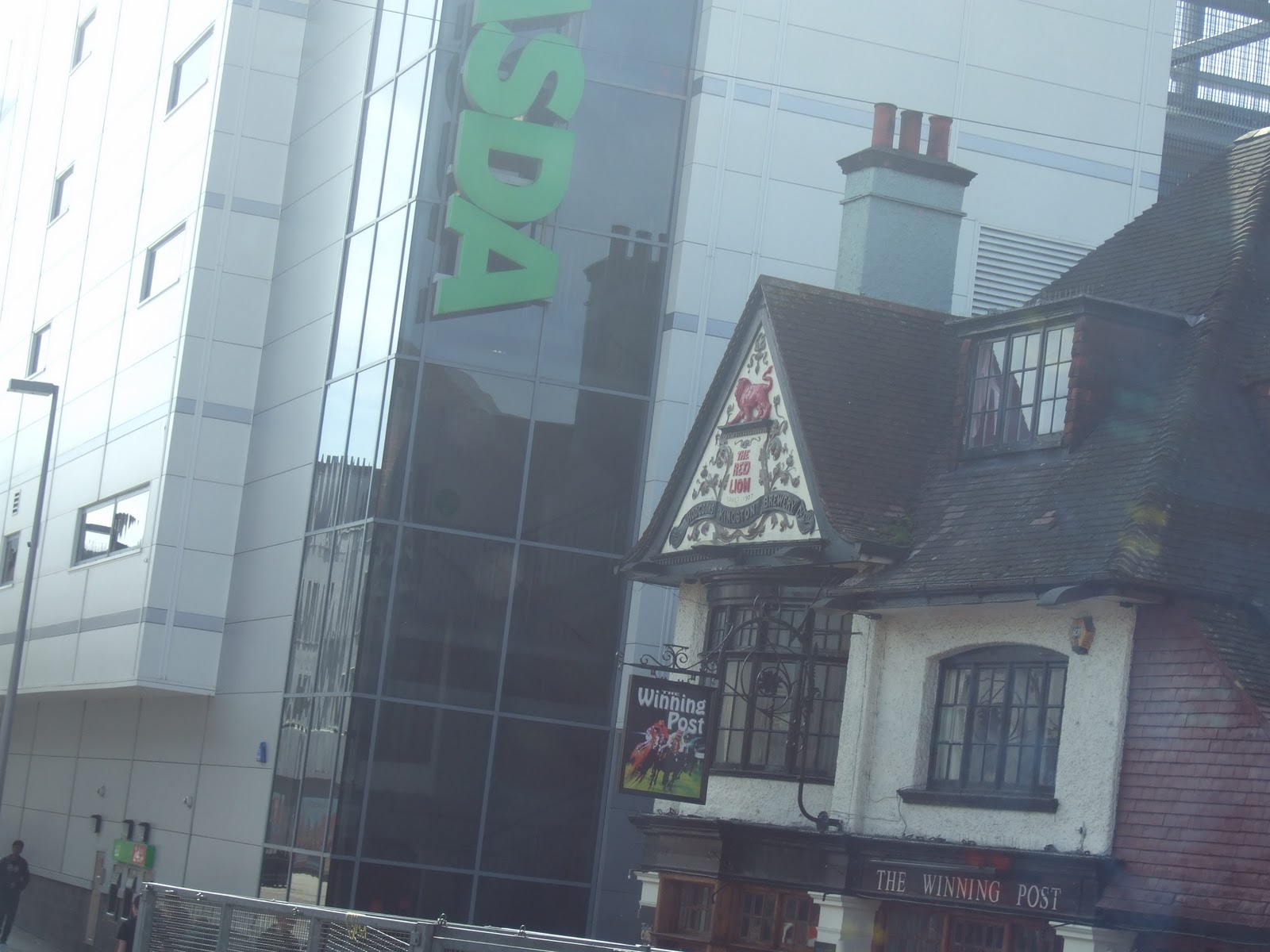
We approached Sutton down Rose Hill, with attractive parks on either side. We were saddened to spot the demise of the Angel pub with its whimsical sign, but a little web research demonstrates that it is not a simple story:  ordered to close for allowing underage drinking, it is now set to become a Tesco Metro.  We did see other pubs in Sutton, however:  the Winning Post which clearly used to be The Red Lion, and then the Cock and Bull.  This phrase, first recorded in 1621, means 'an improbable or unbelievable  story' so is perhaps a reasonable name for a pub, where tall tales may be told.

All the way along Sutton's speedy one way system, the buses pull off to the right, into little oases , so that passengers can get off to the left, although the bus is in the right hand land for its impending right turn.

Local landmarks included the Secombe Theatre, named for the great comedian, Goon and singer, who lived around here, and the Sutton Cricket Club.  The houses as we moved towards Cheam, were attractive and well maintained,  and  the fact that their front gardens had all been converted to hard standing was excusable, given the busy road along which we were travelling.  (The sunshine makes it hard to see the plasterwork and stained glass which we admired).

Cheam Broadway, with a neat village sign, also boasts the Harrow pub, with an archway through to what was presumably once a coaching yard,  and as we left Cheam we also noted the H G Wells Pub.  Apparently he lived 'just around the corner; which is interesting, and a sign of his long life,  as he was born in Bromley, taught in Somerset and spent his last years near Regent's Park, where there is a Blue Plaque for him.

From Cheam to Worcester Park is a very short distance, and we were disembarking in the station forecourt by 12.10, an hour after leaving Wallington.

Tuesday, 8 March 2011

The Number 150 Route

Becontree Bus Station to Chigwell Row (The Maypole)
Monday March 7th 2011

When we started The Project – just 2 years ago today – we had thought that many bus rides would involve some quite tricky trips to the start and finish of the more out of town routes. This has not in fact very often been the case: in spite of our project’s name, most of our journeys have taken us to places where another bus connects to carry us on or back. But today proved to be one of those days, with no chance of making it more than a one route trip …

We (the project was at full strength today) met at Dagenham East Underground Station where the manager told us the weekend works crew had dug their way through a mains water pipe (and walked off) and therefore the advertised station toilets were not available. However he kindly took pity on us and let us use their station facilities, so we said we would record his kind deed for posterity.

A beautiful sunny day meant that our walk from Dagenham East to Becontree Heath was pleasant if uninspiring, and it seemed totally appropriate that our Route 150 we would be starting from an inn, well a Fifties era type pub called ‘The Three Travellers’. It was not a busy bus and most folk boarded only to get off at Ilford – but I get ahead of myself.
The National Trust signs indicated a nearby property at Eastbury Manor, managed by Barking Borough and apparently where the Gunpowder Plot was hatched – it must have been quite a hike back to Westminster from here in Stuart times was the thought that occurred!

Our bus was pretty speedy along here, skimming past the mainly pebbledash inter war housing. These housing developments were largely built without shops and other services, which instead clustered along the still busy Goodmayes and Seven Kings High Streets. I had hoped Seven Kings might be named after a whole heap of Saxon rulers with those novel and unpronounceable names such as Etheldred or Aelfoot ( I made that one up) but it seems more likely it was just Sevve’s settlement. By now we had entered Redbridge whose borough logo seems more like a cannabis plant than a chestnut , but who am I to question what was undoubtedly an expensively commissioned corporate symbol?

Goodmayes and South Park, where we were recently on the 145 all fringe the ever-busy Ilford with its complex one way routings and major bus hub. The Viper Studio offers tattoos of all sorts while the local borough had been busy planting pansies to spell out (we think) Ilford Town centre (ITC) and they certainly make sure all the town’s facilities are clearly signposted.. Strangely, although there is a rather derelict tower block covered in dirty netting around two corners you find an even taller block still being built?
This route leaves Ilford via the Cranbrook Road and past the excellent Valentine’s Park – the lake this morning was full of birds, The approach to Gant’s Hill has speeded up significantly since the last time we were here when it was full of road and landscape improving works (note the pebble street art), so it was a bit sad that there had been a crunch between two cars necessitating police and paramedic intervention. Fortunately it did not look too serious for the drivers concerned, and the road is now wide enough to let the other traffic pass. Going slowly for a bit (hardly anyone requested the bus past Ilford) we saw a nice preschool learning alliance van with a colourful caterpillar.

We had not thought of this part of the world as particularly Jewish but perhaps it’s a handy place to have a wholesale outlet – not sure what they do the rest of the year though?

Though it is not very clearly signposted – how did we miss it? – this route goes past Barkingside, which has long been the HQ of  Barnardo's , the historic children’s charity. When I started work their family group homes were still looking after children out here in Essex and had indeed inspired local authorities to build similar clusters of children’s homes in their own localities. Nowadays Barnardo’s energies are focussed on more local and specific projects – parent advocacy and child sexual exploitation for example. I suppose the sobering thought is that the problems have not changed that much though the responses from Barnardo’s have evolved.

For some reason the shops in Barkingside and Hainault seemed to enjoy names chosen to make you wince such as ‘Toyology’ and even worse ‘Footology’. Even though it was Monday morning there was a wedding going ahead at the handsome Redbridge Registry Office – at the next roundabout there was a much more modern building housing ?library or swimming pool. (In spite or maybe because of the little chestnut/cannabis logo, the Redbridge council website is not the most helpful.)

By now we were on a road so straight it looked positively Roman called the New North Road, and in the far distance we could see trees – the bus pretty much zoomed along here with very few passengers at the many request stops. Housing was getting far less dense, even a few bungalows, and just before entering back into Essex at Chigwell we did a good tour round the well maintained Manford way estate and then rejoined the dual carriageway, the other side of which is Hainault Forest thanks, as this very dedicated website says, to the foresighted folk who in 1903 secured the forest for the public use. The bus has a little lay-by, just opposite the All Saints Church , where it can rest before turning round, and thus we found ourselves ‘out in the country’.

Well we were not really in foresting mode, today but it is impressive that a London bus brought us so far so fast.


PS. It was a bit of a hike back past some impressively large and security guarded properties till we reached Grange Hill Station, bearing not the least resemblance to the BBC School soap that kept my children gripped 3-4 years in the Eighties, though the series ran from 1978 – 2008.


Thursday, 3 March 2011

The Number 149 Route

Edmonton Green to London Bridge
Wednesday March 24th 2010

Our two previous buses had brought us to Edmonton Green bus station, agreeably open and accessible, and close enough to admire the War memorial We also looked into the shopping centre and found some ripish avocados and loos both at a good price.

Relieved we boarded our bendy bus, and sat well forward in a foursome seat, joined for the early part of the journey by a local who pointed out some recent landmarks - the Edmonton police station which had moved into the bigger former Town hall, for example- for us. Single deckers restrict the photo ops and it was busy, making a stately progress back into town.**Since we took this trip the 149 has reverted to being a double decker again

After Gilpin’s Bell – Jo was a little shy of reciting too much in this more intimate setting so you may have to read the William Cowper ballad for yourselves – enough to say that even loaded down with his wine supply his (John Gilpin’s) progress was probably little slower than ours.

Original Skin turns out to offer tattoos which may have also inspired the graffiti style artist Banksy , who has a Perspex-protected work on one of the street corners that the bus passes. Even if not him it’s good fun. The football stadium is one focal point of Tottenham while the other is the cluster of older and civic buildings round South Tottenham and the wealth of buses on offer makes them easy to get to. Just before we left the Seven Sisters Road we noticed the Seven Brothers Supermarket and then took a more easterly turn south into London via Stamford Hill and Stoke Newington. Having passed this way so often now we thought it about time to identify the origin of Seven Sisters – discarding the more exotic descriptions of lakes or cliffs we settled for seven fine elm tress that stood hereabouts.


Thanks to some locals we now know why there are two spellings for Harringay (specific area along Green lanes) and Haringey (the whole London Borough). Our very long and totally legally slow bus was badly carved up by a motorist who cut in suddenly producing a not unjustifiable expletive so I don’t think anyone was going to report our driver who coped admirably.

Stamford Hill has long been the preferred area for London’s orthodox Jewish community and there were clear examples of shops to serve their food, clothing and ritual needs. On the whole they are a very private community so even photographing one of their shops felt intrusive. Other religious communities use different methods of communication and we were quite tickled by a church announcing: >Msg. Frm God:I ♥ U. Now well into Hackney we also spotted a really prettily tiled Mosque. Along the road past the West Hackney Recreation Ground, which seems originally to have been an open space later used for burials and perhaps now reverting to its original use?

By now it was very clear that we were heading for the City of London – on the not so distant horizon the Gherkin’s profile peeped out round another building like some pregnant woman left without a seat on the bus.

We realized why Transport for London had opted for this type of bus as for some miles it could progress in a very straight line not requiring it to bend (which is when they snarl up the traffic) at all. This part of Dalston (the Kingsland road) is that wonderful mixture of old and new housing with some really lovely early 19th homes set in squares off to both sides whilst the High Road has the full London range of Tugra Baklava shops, Scruples piercing and a solicitor offering the full range of legal services including advice on Shariah law. At the point we passed we were witnessing the last works on the East London line, which by the time you read this should be up and running!

St Leonard’s hospital, presumably linked to St. Leonard’s church down at Shoreditch, was originally the Shoreditch work-house, later a fever hospital and now turning into one of those ‘community hospitals’ which seem to be somewhere between a clinic/out-patients and a cottage hospital. Just before the rather fearsome one-way system, where we always go wrong in a car, that is now rather trendy Hoxton and Old Street you pass the lovely Geffreye Museum – again housed in old Almshouses and to excellent effect.


Not diverting and not being diverted we keep on in a straight line which means down past Heron Tower, Bishopsgate Liverpool Street and ‘The Pinnacle’ some buildings more complete than others. To save you working out which is which try this guide, though not absolutely up to date.


While the views are less elevated from a single –decker bus there is the advantage of being able to peer into the various little alleys off to the left, often leading to courtyards which hold pubs and all pretty busy as once again we hit the City at lunch-time and everyone seems on a mission to get food of one sort or another – running a sandwich bar hereabouts must be good business. Though the Monument is now dwarfed by much that surrounds it, the magic is still there and as we cross London Bridge the 149 gains some extra popularity points for being a river crossing route joining very North London (all those N postcodes we went through) to SE1 and London Bridge station – on time too.

Tuesday, 1 March 2011

The Number 148 Route

Monday 28 February 2011

Linda and I (Mary being on grandmother duty) arrived at Camberwell Green to take the second of a four bus day which stretched from Lewisham to Pinner.  Our first bus (about which you will read many months from now) terminates at the right stop, and so we climbed aboard the 148 at 10.40, with almost no wait.  Our pleasure at this seamless transfer was somewhat muted as we took our seats and realised that the driver had had a cigarette in his cab during his break.  Still, it was a horrible day...

Northwards through Camberwell, we noticed as so often before the wide range of religious experiences on offer, including the Redeemed Church, which offered 'digging deep' as one of its forms of ministry;  also the Camberwell Islamic Centre which, as we know, occupies a former pub.  There was plenty to look at as we headed North,  past the entrance to Burgess Park and the Red Lion Pub, a modern building but claiming 'established 1666' in its brick work.
There were tremendous bargains to be had, for example in men's suits, though East Street Market was looking pretty quiet, it being  Monday.


As we came to Newington Library, we wondered about its future, given the plans of various boroughs.  It's alarming that services with 'special pleading' seem to get reprieves:  what happens to important services with no loud voice?  We noted with approval the improvements (nearing completion) to the road layouts at Elephant and Castle.

This is the bus that goes past the main entrance of the Imperial War Museum, as opposed to along the sides, so we were able to glimpse the great naval guns beyond the slim birches and neat shrubs of the Peace Garden.  I feel a metaphor coming on, but shall spare you as there is so much to say about this journey.

The next landmark was The Perspective, a block of flats where Sue once worked;  brace yourselves before you go to the link:  if your eyes don't water at the misplaced apostrophe, they will at the price of a two bedroom apartment.

On to Waterloo Station, and then the huge Park Plaza hotel which forms the roundabout before reaching Westminster Bridge, with its excellent views and Wordsworth references.  I thought you might like a variant on the many photographs we have taken from the bridge so here, courtesy of the Little Gooner, is the Legoland version of Parliament and Big Ben, a depiction lacking the many tourists and the nasty weather of our sighting.  The 148 swings left, past the remains of the Peace Camp and the unsightly fencing preventing its regrowth, and past the Queen Elizabeth II Conference Centre (no crowds, as Chilcott has finished taking evidence) and the Central Methodist Hall.  Along Victoria Street, we felt that Government buildings suffer from names that are too long.  The marketing people at the Department for Business Innovation and Skills presumably chortle with glee at the thought that we might call it 'BIS', but we were unamused.

Westminster Cathedral and then Victoria Station were next, and we felt some nostalgia as it has been a while since we passed the statue of Marshal Foch, the strange shell-encrusted huts of Grosvenor Gardens, enlivened by a fine display of primulas, and  the walls of Buckingham Palace garden.


Around Hyde Park Corner, we headed up Park Lane, with more memorials for our delectation: after the Queen Mother's Gates, and that strange huge statue of Achilles that caused such a row in the 19th century till it was figleafed , we came to the memorial for the 7 July 2005 victims.


On our other side, in the central reservation of Park Lane, we were amused by an art work depicting a child's hand with a toy car - a Fiat, since the artist is Italian.  Then we passed the memorial to the Animals at War, with the Kiplingesque pack mules and camels before coming to Marble Arch with some more new art in the form of a family of jelly babies.

Along the Bayswater Road, we passed Tyburn Convent, a Benedictine monastery on the site of the gallows at Tyburn where a number of Roman Catholics were executed in the reign of Elizabeth I (about as many as the number of Protestants burned for their faith in the previous reign, which provides some kind of balance, I suppose)  We also admired the fine refurbishment of The Lancasters, though regret the fact that the apartments are all 'Price on Application' so we can't be amazed in this blog.  The Hire Bike racks in the park along here were all empty, which suggests serious usage even on a cold wet day.  This is also where there is a Blue Plaque for J M Barrie.  A few minutes later, the other side of Notting Hill, we noted a plaque for James McBey, Artist.

Here we were held up for a while by a car driver who had chosen to leave his car at a bus stop, right by some road works, while he went into 'Frame Set and Match'. Yes, driver of H785HRY, I mean you. Eventually he moved on, and so did we, passing Holland Park Tube, with memories of Sylvia.  We were sorry to see that Tesco has replaced the grocer who used to be there, but that's progress, I suppose.

Passing Norland Square, noted for nannies, and Royal Crescent, looking like a refugee from Bath, we reached Shepherds Bush.  We were puzzled by the war memorial, which has a winged figure with a sword, so it is reassuring to learn that she is Peace: the sculptor, Henry Charles Fehr, chose to depict the winged figure with a sword pointing downwards.

We travelled round Shepherds Bush Green to pass the Bush Theatre and the ornate Empire Cinema, before turning towards the White City Bus Station.  It was 11.35. Linda was disappointed that we terminated without going in:  it is our favourite bus station, we think;  but we only had to cross the road to pick up our next bus.

It seems to us impressive that it should take less than an hour to travel this far west from Camberwell:  and we enjoyed the substantial number of famous sites and sights along this excellent route.